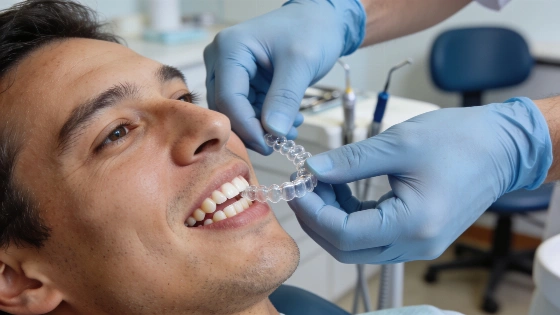
Before an aligner is made, software lays out a sequence of proposed tooth movements. The simulation is a plan, not a promise: teeth move through a biological process that software cannot fully predict. Clinicians have to compare the projected sequence with what is happening in the mouth.
Across studies, the average accuracy of different clear-aligner movements has been estimated at roughly 50-60%, with substantial variation depending on the type of movement.
A refinement is an updated aligner sequence based on new records. It gives the clinician a fresh starting point when the original sequence has not achieved its intended result. Published clinical data summarized by Zusin Dental indicate that more than 70% of clear-aligner cases required at least one additional refinement stage. Rotation may fall short, while extrusion can also prove difficult. Controlling front-tooth torque presents another challenge, as discussed in a clinical review of aligner movements.
The simulation is a route map, not a forecast
Invisalign treatment uses digital models to plan stages of tooth movement before aligners are made. The clinician can review how each tooth is expected to move and whether the sequence appears compatible with the patient's bite. Other clinical considerations matter too. The final arrangement is only one part of the assessment: the proposed route must be mechanically feasible and biologically appropriate.
In a study of lower-canine rotation with Invisalign SmartTrack, optimized attachments achieved about 81.5% of planned rotation with weekly aligner changes and 76.5% with two-week changes; conventional vertical rectangular attachments achieved about 63.1%. None of the approaches was considered clinically equivalent to fully achieving the plan.
The concern about biological limits also appears in a separate clinical framework. In aligner care, the principle is similar: a digital setup makes proposed movement easier to inspect, but it cannot decide what is appropriate for an individual patient.
Scans make planning and monitoring more visible
Intraoral scanners capture tooth surfaces and create a three-dimensional model. Clinicians can rotate the model and take measurements. They can also compare it with later scans. Unlike a physical impression, a scan can be reviewed during the appointment, so incomplete areas can be captured again. Stored scans help clinicians assess changes over time and compare progress with the initial plan.
That comparison matters once treatment begins. Clinicians check aligner fit and tooth movement, then look at attachment integrity. They also assess bite changes and patient symptoms. A new scan can show whether teeth are tracking as expected. Some systems support remote monitoring through patient-submitted images, but those tools do not replace professional oversight or in-person examinations when clinically necessary.
More data does not automatically mean better care. The clinician still has to judge whether a difference matters and what action it warrants.
Digital models can make treatment easier to explain. Patients can view current tooth positions from different angles and review proposed changes stage by stage. That can support clearer conversations about goals and limitations. A polished simulation can also create unrealistic expectations. Tooth shape affects the final appearance. So do gum contours and other features.
Case selection remains a clinical decision
Digital planning does not make every orthodontic case suitable for Invisalign. Mild crowding or spacing may be relatively straightforward. Significant skeletal discrepancies can be harder to address, as can complex tooth movements. Fixed braces or auxiliary appliances may be more appropriate. Some patients may need coordinated restorative care, with periodontal or surgical treatment also considered.
Oral health and existing dental work matter as well. Crowns or bridges can affect treatment options. Implants and missing teeth matter too, while compromised supporting tissues require careful consideration before teeth are moved. A digital model is one part of that wider clinical assessment, not a substitute for it.
At Union Square Dental Practice in San Francisco, digitally planned Invisalign care is offered alongside restorative and preventive dentistry. The practice is led by UCSF School of Dentistry graduates Dr. Mahsa Hakim and Dr. Nazanin Hakim. It has served the local community for more than two decades.