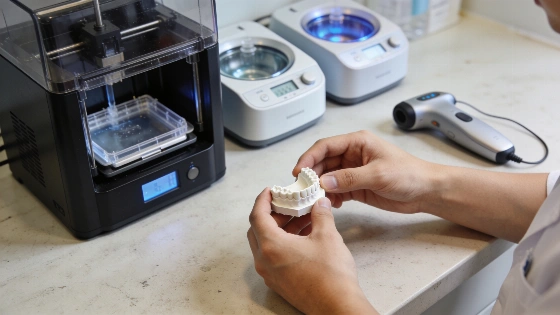
More than 80% of chairside print jobs in SprintRay's analysis involve one patient and one case. The company says that pattern shaped Nano Series, a compact workflow designed for dental practices rather than multi-case production. SprintRay says the setup, built around NanoPrint and NanoWash, takes up 28.3 inches (72 cm) of counter space, about 40% less than its previous solution. NanoCure is also part of the workflow.
The devices pass case and material information between stages. NanoCure was introduced in 2024, so its role in Nano Series is as part of the connected workflow, not as a newly introduced device. Together, the system links digital scanning and design to production and post-processing.
Foundation brings scanning into SprintRay's platform. The wireless, full-color intraoral scanner weighs 235 grams and has autoclavable tips. It is built for ScanOS, SprintRay's scanning software, which is integrated with the company's cloud dashboard. Once a scan is complete, files are available in the cloud for design and production without a separate export or upload step. SprintRay describes the device on its product page. Institute of Digital Dentistry reports that the scanner is technically associated with Alliedstar. It uses local scanning software, while case management and production connect to SprintRay's cloud environment.
Foundation is expected to begin shipping in the United States in November 2026. Institute of Digital Dentistry reported a regular retail price of about $11,000 and a promotional 3DNext price of $9,995.
ScanOS puts scanning alongside SprintRay's design and production tools. CEO and co-founder Amir Mansouri said the company had previously connected scanners and printers through third-party integrations, forcing practices to move between systems.
NanoPrint uses a 385 nm light engine. Its AutoPrint feature places, orients and supports a model on the build platform. NanoWash runs a sealed six-minute wash-and-dry cycle directly on the print platform, while NanoCure handles post-processing. SprintRay says Job Handoff passes case identifiers and material details between devices, matching later processing to the resin. The company's NanoPrint product information describes compatibility with SprintRay materials. It also says the system accepts connected files from Foundation and Design Suite, as well as files from other scanners or software.
NanoWash uses RFID to identify the solvent tank and select a wash program. Vapor exits through an exhaust port. NanoCure connects to SprintRay Cloud to receive jobs and updates, and its software runs on Android. SprintRay's NanoWash product information describes the automated cycle. The series supports applications using SprintRay's validated materials library. Indications and availability vary by market.
Institute of Digital Dentistry listed NanoPrint at $8,995 and NanoWash at $1,999, with a launch bundle price of about $10,000. Orders for both devices were scheduled to open on October 10, 2026, with initial U.S. shipments expected to begin November 2. Announced Nano Series markets include the United States and Canada. Australia and New Zealand are also included, and the European Union is an announced market. Availability is subject to regional regulatory requirements. NanoWash is not included in the Canadian launch offering.
SprintRay and GC Corporation announced GC GRADIA® PREMi, a hybrid ceramic restorative resin developed for the Midas Digital Press workflow. Its clinical indications and performance claims remain subject to GC's final approved product labeling. Regional availability also depends on regulatory review.
A separate report on Sulaimani teaching clinics covered students treating real patients under supervision.
The announcements were made at 3DNext 2026 in Miami Beach. Nano Series shipments are expected to begin in November 2026, with initial U.S. deliveries scheduled for November 2. Foundation is also expected to begin shipping in the United States in November. Availability in other markets remains subject to local regulatory requirements and product availability.