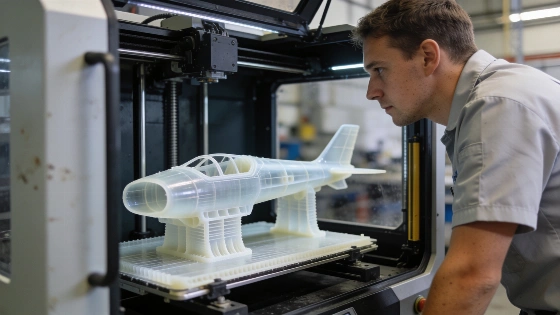
At 914 x 610 x 914 mm, the new build envelope gives AFD Systems room for larger polymer aerospace parts. The company added a Stratasys F900 to expand production under its existing UK aviation approval. The installation was reported on October 7, 2026, as Industrial News reported.
The F900 supports ULTEM and Antero PEKK. AFD plans to make larger flightworthy components on it. The printer can also handle production tooling and low-volume aerospace parts that could not fit in the company's previous equipment.
AFD received Part 21G Production Organisation Approval from the UK Civil Aviation Authority earlier this year. The company says it was the first UK business to receive that approval specifically for polymer AM in aviation. It lets AFD manufacture components using approved design data and release them with the required airworthiness documentation.
Part 21G controls require records and traceability. They also require inspections, along with evidence that each part conforms to its approved design. The rules cover material identification and handling. They set controls for build parameters, equipment condition and post-processing. The F900 expands AFD's existing certified production system.
In Australia, AXT and Stärke Advanced Manufacturing Group agreed in October 2026 to develop polymer AM capacity at Stärke-AMG's Adelaide facility. AXT plans to install a Stratasys H350 using Selective Absorption Fusion technology to produce nylon and polypropylene parts. Small drone prototypes are among the first planned applications.
Further work is aimed at aerospace and defense. The partners also plan to explore autonomous systems. They will assess recycled SAF materials and defense-oriented FDM materials, as Australian Defence reported.
The H350 will add polymer production to Stärke-AMG's operations. The company already runs metal AM equipment and machining operations. Earlier this year, it expanded metal capacity with three Renishaw AM400 systems through a partnership with Flinders University. The H350 is intended for polymer production, while the AM400 systems support the separate metal AM operation. No government funding has been announced for the H350 installation.
Mimir completed its acquisition of metal powder producer Osprey from Sandvik on October 1. The deal was announced and signed in May. Osprey now operates independently, with facilities in Neath, Wales, and Sandviken, Sweden.
Osprey produces gas-atomized metal powders. Its portfolio also includes alloys and engineering materials for advanced industries. The company supplies aerospace and defense markets, as well as medical and energy customers. Other advanced industries also use its materials. More than 50 years of gas atomization experience underpin production of over 2,000 powder grades covering more than 400 alloys for AM and other processes, as 3D Printing Journal reported.
Mimir plans to invest in new alloys and product development. It also intends to expand internationally, including in AM markets. Osprey says existing customer contracts will remain unchanged during the transition. The company says production lines and specifications will stay unchanged as well.
Swedish investment company NAXS disclosed a SEK 5 million investment alongside Mimir on October 5. MonteCap is also co-investing. The purchase price has not been disclosed.
In South Korea, Graphy agreed to supply MegaGen Implant with Tera Harz E-Namel resin under a KRW 2 billion agreement. The deal also covers 3D printers and post-processing equipment. It draws on MegaGen's dental industry network to expand Graphy's commercial reach. The arrangement is detailed in the supply agreement report.
Graphy has also acquired a 26.14% stake in dental imaging company Ray. The companies are reportedly discussing a separate annual supply agreement involving Ray's imaging systems. That agreement has not been finalized.