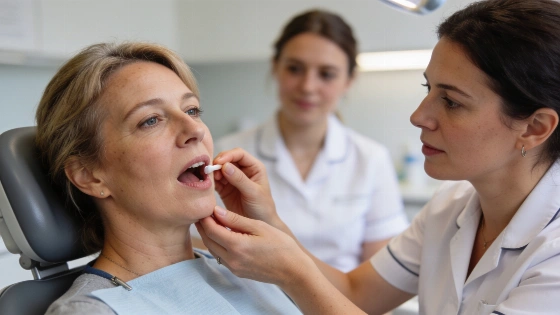
At a dental appointment, dry mouth can be recorded as a symptom without prompting a conversation about menopause.
A 2023 Delta Dental survey found that about 70% of women reported at least one oral health symptom during menopause. Only 2% said they had ever mentioned one to their dentist. Those figures describe the survey's respondents, not a universal estimate. The gap points to a problem beyond patient awareness: dental teams may not be trained to ask.
In the UK, around 13 million women aged 45 and over are perimenopausal or menopausal. More than half of dental patients will be affected at some point in their lives. Yet around 90% of the public does not know menopause and oral health are connected, according to Berry and Tighe (2025).
Symptoms can be mistaken for routine dental problems
Falling oestrogen levels may affect the mouth because oral tissues and salivary glands have oestrogen receptors. Adam and Wooton (2022) discuss reduced salivary flow and dry mouth among the oral symptoms associated with menopause. Their review also covers burning mouth syndrome and altered taste. Periodontal disease may be accelerated by oestrogen-driven bone loss. These symptoms are not specific to menopause.
Saliva helps buffer acids and control microbes. It also keeps the mouth comfortable. Reduced flow can leave patients more vulnerable to tooth decay, while the oral lining may become irritated. Medication can cause dry mouth, and other health conditions can contribute too. A dental assessment should therefore include a review of medicines alongside the patient's health history, rather than attributing symptoms to hormonal change alone.
A burning tongue or a sudden change in denture fit may warrant a wider conversation. So may unexplained taste disturbance. Gum recession that does not respond to hygiene measures is another reason to look beyond routine care.
Burning mouth syndrome describes chronic burning or pain without obvious changes to the oral lining. It can occur alongside dry mouth or altered taste. Bleeding or sore gums are not specific to menopause: gum recession can contribute, as can enamel wear. Decay and other dental conditions may also be responsible. Without that context, a clinician may address dryness or bleeding separately and handle denture fit as another issue, without asking whether hormonal changes could help explain the symptoms.
The need to look beyond brushing alone also appears in coverage of interdental care for older adults. Menopause-related symptoms call for their own clinical context.
Training and a consistent pathway
Practitioners surveyed by Williamson and Reed (2023) said they left dental school with "zero knowledge" of menopause's oral health effects. That lack of preparation can leave clinicians less confident about raising the subject. Patients may hesitate to discuss a private or ageing-related experience. Clinicians, meanwhile, may attribute oral changes to hygiene rather than hormonal factors, leaving menopause-related symptoms to fall through the cracks.
Sarika Shah's Menopause Mouth Matters campaign aims to put the subject on the profession's radar. She is also developing the Shah Menopause Oral Health Index (SMOHI), a chairside screening index that is on the pathway to ethical approval for a pilot study.
The proposed index would give dental teams a consistent structure for asking about menopause and assessing related oral symptoms. It is also intended to help teams manage issues within their scope. When a referral is appropriate, the index could guide onward care. Possible routes include a GP. A menopause specialist is another option, as is a different allied healthcare professional. The index has not yet reached the pilot stage.
Shah argues that menopause should be core clinical knowledge in dental training, rather than an optional extra. With only 2% of women saying they have raised oral symptoms with a dentist, her proposal would make the conversation routine and connect dental care with wider healthcare referral pathways. Dental check-up intervals can be tailored to individual risk, as outlined by Northamptonshire Healthcare NHS Foundation Trust.