
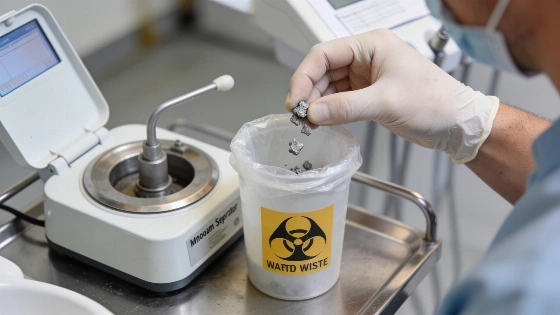
A restoration removed during routine treatment can still enter a practice's waste stream decades after it was placed.
Millions of fillings already in patients' mouths will continue to be removed when restorations are replaced or teeth are extracted. That leaves dental practices managing a shrinking but long-lived source of hazardous waste.
The policy position described in this report is that the manufacture, import and export of dental amalgam will be phased out, while dentists may still use it where clinically necessary. However, the available GOV.UK results did not provide a new regulatory instrument confirming a UK timetable specifically for a 2034 phase-out.
ONS datasets include official statistics on dentistry and access to dental services, but the available material does not provide a prevalence estimate for amalgam fillings or a forecast of amalgam waste volumes.
Existing fillings will define the waste timeline
Analysis by BusinessWaste.co.uk estimates that around 27.2 million adults in England could have at least one amalgam filling. The estimate uses the Adult Oral Health Survey 2023 alongside Office for National Statistics population figures and includes approximately 1.3 million people aged 16-24.
Those figures were not independently confirmed in the available official results. They should therefore be treated as an industry estimate rather than an established national statistic.
The age profile matters because amalgam waste is not confined to older patients. Individual fillings present around 2034 could remain in place until the 2040s or 2050s, although some will be removed earlier and others may last much longer.
The waste timeline follows the lifespan of restorations rather than the date on which new supplies disappear. The Office for National Statistics provides official dental and service-access data, but the material reviewed here does not quantify the number of amalgam restorations still in place.
GOV.UK's Heavy Metals Monitoring Network materials were updated in October 2026, but the available result does not connect that monitoring directly with the handling or disposal of dental amalgam waste.
Practices still need controlled handling
Mark Hall, dental waste disposal expert at BusinessWaste.co.uk, said: 'The amount of amalgam being used may fall, but existing fillings will continue to be removed for many years. That means practices will still need suitable processes for separating, storing and transferring amalgam waste, even when they are dealing with much smaller amounts of it.'
Practices removing amalgam must use separators that retain at least 95% of amalgam particles and arrange collection by an authorised hazardous waste operator. The 95% performance figure and the related operational requirements were not confirmed in the available official results reviewed for this article.
Practices should check current requirements from the Environment Agency and NHS England, alongside hazardous-waste rules, before relying on those figures or procedures.
The Medicines and Healthcare products Regulatory Agency is responsible for regulating medical devices in the UK. Its official organisational information does not set out special dates for ending the manufacture, import or export of dental amalgam, as shown by the MHRA regulatory information.
For dental teams, this is a long transition rather than a clean break. As earlier coverage of ageing oral health shows, existing restorations and continuing treatment needs can shape practice demands long after a wider policy shift begins.
The 2034 phase-out will not remove the need for waste controls. Practices will still have to separate, store and transfer fillings removed from patients, while the clinical life of existing amalgam extends into the 2040s and 2050s.