Korean reporting says the deal is Graphy's first supply contract to cover Tera Harz E-Namel. The initial agreement is worth KRW 2 billion and includes long-term crown resin supply, 3D printers and post-processing equipment.
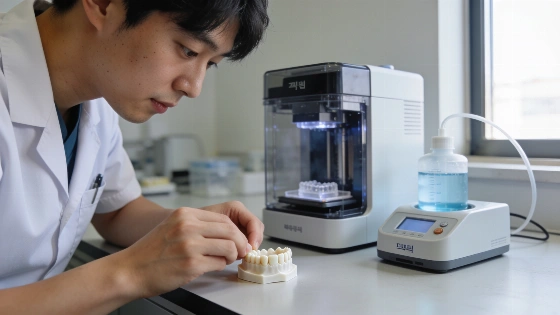
The package covers Tera Harz E-Namel, a light-curing resin with 53% inorganic ceramic filler in a polymer matrix. It is designed for directly printed digital crowns, bridges, inlays and onlays. Graphy is supplying the production chain, not just a standalone material.
Graphy received Korean certification for Tera Harz E-Namel as a class II medical device categorized as resin for dental crowns on September 7, 2026. Commercial launch followed on September 15, 2026.
That difference matters to laboratories and dental practices weighing digital manufacturing. Buying resin alone does not create a working production line. This agreement links the material to the equipment needed to print and finish restorations.
A commercial workflow built around crown production
Graphy will provide MegaGen with Tera Harz E-Namel, 3D printers, nitrogen curing units and resin removal equipment. Korean financial reporting put the initial package at KRW 2 billion and listed the material, printers, nitrogen polymerization systems and resin-removal equipment as parts of the deal.
The companies signed the agreement at Graphy's headquarters in Seoul. Graphy Group Chairman Sim Un-seob, MegaGen Chairman Park Kwang-bum and representatives from both businesses attended the ceremony.
Park said he had used Tera Harz E-Namel in approximately 50 clinical cases. He pointed to shorter production times, lighter restorations, easier occlusal adjustment and patient comfort. He also reported positive observations about strength and shade reproduction compared with conventional dental prosthetic resins.
Graphy has filed a U.S. FDA 510(k) notification for Tera Harz E-Namel, but the available reporting does not confirm that the FDA has already granted clearance.
Those claims come from Park's reported clinical experience. The announcement does not describe an independent comparative study. That distinction matters as the product moves from a company partnership into wider professional use.
From implant treatment to a connected digital pathway
The companies are also in the final stages of talks on an annual supply agreement for CBCT systems made by Ray Co., Ltd. Graphy holds a 26.14% stake in Ray. The proposed arrangement is not final. Available independent reporting does not confirm that the companies have signed it or that Ray has delivered any CBCT systems.
If the plan goes ahead, it would connect Ray's digital diagnostic technology with MegaGen's implant solutions and clinical expertise, as well as Graphy's 3D-printing materials and production systems. The companies call this proposed pathway a "K-Dental Workflow." It would link diagnosis, implant treatment and the production of 3D-printed restorations.
The plan fits a broader move toward integrated digital dentistry. As earlier implant coverage has shown, implant care is increasingly discussed as part of wider service networks rather than as an isolated procedure. Here, the proposed link is both technical and commercial: imaging, treatment planning, implant care and restoration production would sit within one partner network.
Regulatory expansion remains ahead
Tera Harz E-Namel received Korean class II medical-device certification for use as resin for dental crowns. Commercial launch was reported in September 2026. Graphy has submitted a 510(k) notification to the U.S. Food and Drug Administration, but available reports do not establish that U.S. clearance has been granted.
The companies plan to build on the initial agreement with clinical education, technical support and wider supply in Korea and international markets. Sim Un-seob said Graphy wants to support adoption in dental practices and laboratories and develop a long-term relationship based on repeat orders. Park said MegaGen plans to bring Graphy's technology into its digital treatment workflow to improve clinical outcomes for patients.
Graphy's position also includes its wider materials portfolio and its 26.14% stake in Ray. The company began with orthodontic applications, including its direct 3D-printed Shape Memory Aligner, and is now moving into restorative dentistry.
The immediate deal is more than a resin sale, but it does not prove that the full K-Dental Workflow is in place. The concrete facts are the KRW 2 billion supply commitment, the class II Korean certification and the September commercial launch. U.S. regulatory clearance and the expanded imaging arrangement remain pending.