
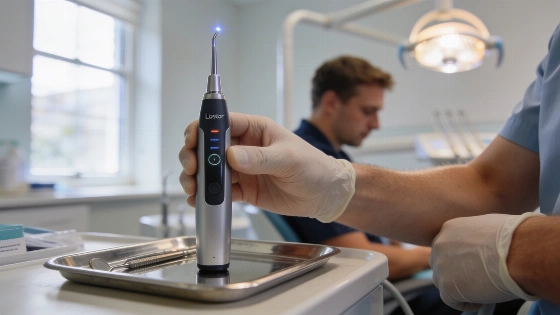
Dental providers in England delivered 37.6 million Courses of Treatment during 2025/26. That activity is helping expand the market for laser equipment.
The UK dental lasers market is forecast to reach USD 43.3 million by 2032, with an 8.1% CAGR from 2026 to 2032. Higher treatment volumes, NHS dentistry reforms, greater clinical capacity and practice upgrades are pushing adoption.
Around 18.8 million adults in England were seen by an NHS dentist during the 24 months to March 2026, equivalent to approximately 40% of the adult population. The comparable figure a year earlier was about 18.0 million.
Clinical demand is widening the equipment opportunity
Dental activity reached 76.8 million UDAs in England during 2025/26. The total rose 6.2% from the previous year. A total of 25,419 dentists recorded NHS activity, according to industry coverage of NHS figures.
That creates a broader customer base for equipment suppliers.
Children drove part of the increase. About 7.17 million children received NHS dental care in 2025/26, or roughly 60% of children in England. Children's Courses of Treatment rose to approximately 13 million.
Practices are responding to demand for preventive, routine and urgent care. The commercial case is getting harder to ignore.
Manufacturers are designing systems that combine several wavelengths and procedures on one platform. Dentsply Sirona's SiroLaser Blue uses 445 nm, 970 nm and 660 nm wavelengths. Fotona's LightWalker combines Er and Nd technologies.
Urgent courses of treatment increased by 8.4% in 2025/26. Since 2019, urgent activity in the 10% most deprived areas of England has risen by 23.6%, while it has fallen by 1.2% in the least deprived areas.
Laser use in implantology is part of a wider equipment shift described in an earlier implant analysis. Periodontal, endodontic, surgical and restorative work is also expanding the potential user base.
Compliance remains the cost of adoption
Market growth does not remove the operational burden. Manufacturers and importers that supply the UK must meet medical-device registration, conformity assessment, post-market surveillance and safety requirements.
The MHRA requires medical devices placed on the Great Britain market to be registered. CQC guidance covers risk assessment, controlled areas, staff training, eye protection, maintenance, quality assurance and incident reporting for commonly used Class 3B and Class 4 lasers.
The rules can raise compliance and implementation costs, especially for smaller suppliers.
Buying a laser is not only a technology decision. Practices also need to plan for training, controlled use, maintenance and documented safety processes.
The market is moderately consolidated. The five largest players are expected to generate approximately 50% of 2026 revenue.
That puts pressure on manufacturers to offer flexible platforms and portable systems. Buyers must weigh clinical range against regulatory and service demands.
At the end of 2025, the UK had 131,680 registered dental professionals. The total included 47,916 dentists.
The workforce figures support the growth forecast, although access and capacity remain uneven. Industry and NHS commentary continues to link reform with prevention, workforce support and digital innovation intended to improve access and quality of care.
The next phase will test that balance.
Treatment volumes, workforce capacity and multi-application technology all support the forecast. Adoption will favour suppliers and practices that turn broader laser capability into compliant, well-managed clinical workflows. Equipment growth alone will not be enough.