
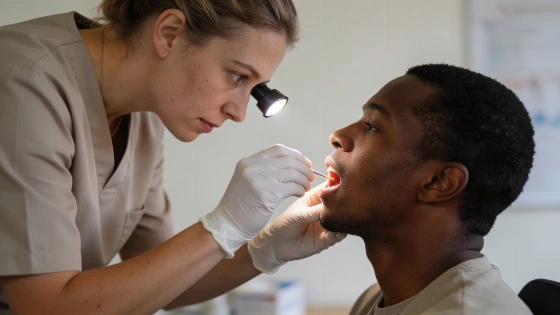
In 2024, WHO revised the oral health module used in its STEPwise approach to noncommunicable disease risk factor surveillance. The change gives countries a simpler way to collect oral disease data during national surveys.
WHO estimates that oral diseases affect about 3.5 billion people worldwide. This figure describes the combined burden of oral diseases, not the number of new cases recorded in a single year.
A broader surveillance framework for oral disease
STEPS is a standardized system for tracking behavioural and biological risk factors linked to noncommunicable diseases. WHO revised the oral health module in 2024 because countries need reliable information on oral diseases and access to care. The change also fits the push to include oral health indicators in primary health care and NCD monitoring.
The new approach uses self-reported information and a short clinical assessment. Together, they give health authorities a clearer way to track oral health programmes and policy implementation. Oral disease stays within national NCD surveillance instead of being handled only through specialist dental studies.
The distinction matters. A dental research guide describes the same methodological divide between specialist dental research and population surveillance.
WHO's global oral health strategy treats prevention, access to care and comparable data collection as interconnected priorities. Regular national monitoring helps countries assess programme coverage and identify inequalities in access to treatment.
What the revised module measures
The questionnaire covers oral health indicators that can guide policy and access to care. Its clinical section is deliberately short. Trained oral or non-oral health providers can conduct it, so more survey staff can take part.
The measure is brief. WHO developed the revision with international experts and WHO collaborating centres. It also aligns with the WHO Global Oral Health Action Plan 2023-2030 monitoring framework and global burden of disease requirements.
Recent dental-medicine research points in the same direction. A 2026 clinical review describes the continuing effort to connect oral-health evidence with wider health-system practice.
"The updated STEPS Oral Health Module gives countries a practical way to integrate oral diseases into broader NCD surveillance. By generating data on oral diseases alongside other NCDs and their shared risk factors, it provides the evidence needed for better decision-making, more effective prevention strategies and stronger health systems," said Dr Søren Brostrøm, Director, Department of Noncommunicable Diseases and Mental Health, WHO.
The Bulletin of the World Health Organization published the article presenting the revised module. Its value will depend on whether countries can use the simpler design to produce consistent evidence for oral health policy and programme monitoring.
The shift is practical. It moves oral disease data closer to routine public health surveillance instead of treating it as a specialist add-on.
Available search results do not independently confirm later policy decisions, implementation outcomes or official evaluations of the updated STEPS module after the reported event. The 3.73 billion figure used in Listerine campaign materials belongs to commercial communication. It does not represent a new official regulatory decision or a newly published national STEPS survey.