
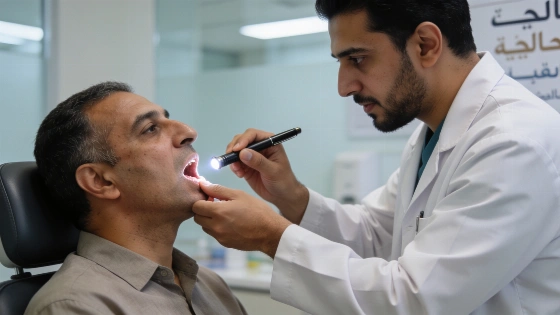
Only 24.7% of 1,095 surveyed physicians in Saudi Arabia said they often or always checked patients' oral health during COPD care.
Available evidence does not confirm that oral-health assessment has become a mandatory requirement at every COPD visit under current global guidance.
Confidence separates routine assessors from the rest
The cross-sectional survey covered general practitioners, pulmonologists and critical care physicians across Saudi Arabia. Data collection ran from October 2025 to April 2026.
Physicians had neutral to moderately favorable views about adding oral health to COPD care. Their confidence in carrying out the related tasks was only moderate.
Confidence was the clearest practical signal. Each one-point rise in the confidence score was linked to threefold higher adjusted odds of routinely assessing oral health. The adjusted OR was 3.00, with a 95% CI of 2.26 to 3.99.
More favorable attitudes were also independently linked to assessment. Pulmonologists had 65% higher adjusted odds than general practitioners.
A review of the Saudi Health Council's public news listings found no confirmed subsequent official decision, protocol change or government measure linked to this physician survey. The available record also contains no verified direct statement from Saudi health authorities, GOLD or a professional dental organization specifically addressing the survey findings.
Only 30.0% of physicians often or always asked about oral hygiene practices. Just 29.8% regularly consulted or worked with dental professionals.
Among the 648 physicians who assessed oral health at least sometimes, recording the problem in the medical record was the most common response to poor oral health. It was reported by 45.2%.
Basic education followed at 33.2%. Monitoring over time reached 31.2%. Only 19.8% said they consulted dental professionals.
Training and workflow leave oral care without a clear owner
Lack of formal training was the most common barrier, cited by 38.5% of physicians. Insufficient time affected 28.1%.
Another 24.1% were unsure whether oral health assessment belonged within their professional role. A further 22.6% cited the lack of workplace protocols.
The pattern points to a workflow problem as well as a training gap. After adjustment, previous formal oral health training was not independently linked to routine assessment. Confidence and attitudes remained linked to practice.
A training course alone is unlikely to close the gap. Physicians also need clear expectations, referral routes and time for oral health checks during COPD care.
That lesson applies to prevention more broadly. As earlier prevention reporting has shown, routine advice is weaker when it is not paired with structured review and proper escalation.
What the findings mean for COPD services
The study points to practical changes. COPD services could set clearer protocols and specify when physicians should assess oral health.
They could also create direct dental referral routes. Collaboration between medical and dental professionals could become part of routine care.
The evidence has limits. The research was cross-sectional and relied on self-reported practice, so it cannot establish causal relationships.
The results came from Saudi Arabia. They should not be treated as a universal measure of physician behavior elsewhere.
Reviewed public records provide no verified indication that the survey has already led to a Saudi regulatory decision or a formal change in clinical protocols. The Saudi Health Council news listings do not confirm such a follow-up.
That does not show that no action will ever be taken.
Even with these limits, the finding is hard to dismiss. Oral health assessment is still too inconsistent to count as routine COPD care.
The strongest response is not to blame individual physicians. It is to build systems that make assessment visible, documented and linked to dental support. Without that infrastructure, comprehensive COPD care will continue to leave a preventable clinical need at the margins.
Study citation: Siraj RA et al. Oral health in chronic obstructive pulmonary disease: are physicians prepared to integrate it into routine care? Front Med (Lausanne). 2026;13:1945808. doi:10.3389/fmed.2026.1945808.