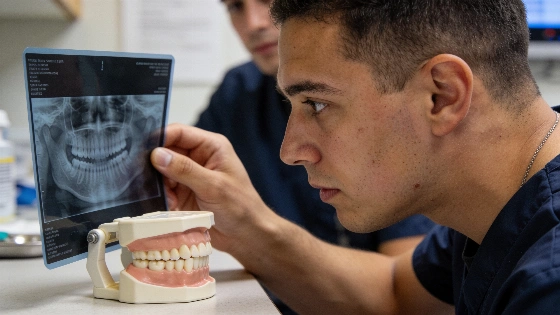
On Sept. 18, 2026, dental clinicians gathered for a full-day VA symposium as the agency moved AI closer to diagnostic workflows.
Attendance peaked at 403. By the end of the event, attendee confidence in AI knowledge had risen from 22% to 52%. Dr. Owais Farooqi, Program Chair and Chief of Dentistry at VA Greater Los Angeles Healthcare System (VAGLAHS), said the focus had shifted from foundational concepts to clinical use. He said clinicians and students need to assess AI outputs critically.
That shift puts oversight at the center of implementation. A review of AI governance in health care describes a framework grounded in patient autonomy and safety. Transparency and accountability are central, alongside equity and sustainability. The six WHO principles for AI in health call for protecting autonomy. They also promote well-being and safety, require transparency and accountability, and support inclusiveness and equity.
Clinical promise and practical safeguards
Presenters said dental AI tools could help detect problems earlier and improve diagnostic accuracy. In orthodontics, personalized care could reduce the need for in-person visits. They also discussed potential benefits for Veterans in remote or rural communities. The symposium covered predictive risk modeling based on imaging and charting. Natural language processing was another area of discussion, along with AI's role in dental education and radiology training.
Speakers also warned that relying too heavily on AI could erode practitioners' skills. It could make authentic diagnostic images harder to distinguish from AI-generated ones. They urged clinicians to review AI outputs actively and retain the expertise to assess findings on their own. A contemporary review of AI in orthodontics flags data quality and algorithmic bias. It also identifies gaps in external validation and explainability. Patient privacy and regulatory oversight remain concerns. The review describes AI as a clinician-supervised decision-support tool, not a replacement for professional expertise.
VA staff were introduced to Copilot and VA GPT. Presenters said the platforms are built to handle Protected Health Information, or PHI, and Personally Identifiable Information, or PII, securely. They stressed that deployment requires safeguards and governance. The symposium also covered military dentistry workflows and residency programs. Other topics included scaling across large Dental Service Organizations, remote monitoring, material selection and regulatory hurdles. For dental AI products, the permitted purpose and functions of a device matter. FDA authorization for a specific diagnostic task does not remove the dentist's responsibility to make the diagnosis and determine treatment.
The focus on accountability echoes concerns raised in earlier coverage of adoption risks: dental teams must weigh safety and responsibility alongside capability. Dr. Patricia Arola, a symposium participant and Former Assistant Under Secretary for Health for Dentistry, described the change as a move "from curiosity to accountability." Governance guidance says organizations should define which tasks may be delegated and which actions require human confirmation. It also calls for clear processes to report and review incidents. The health care professionals' governance framework highlights transparency and explainability. It also stresses traceability, auditing and ongoing monitoring after deployment.
Training and governance
Further education is available through the Artificial Intelligence in Dentistry Education & Research Collaborative (AIDEC), a VAGLAHS Dental Service initiative focused on education and scholarly research.
A separate "Artificial Intelligence in Dentistry" training series was launched in collaboration with VAGLAHS and SimLEARN. The Institute for Learning, Education, and Development (ILEAD) also collaborated on the series.