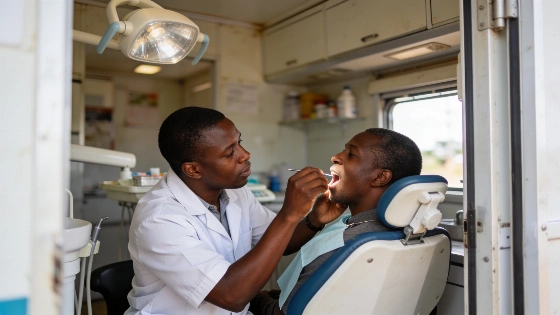
The Community Oral Health Outreach Project dates to 1983. Its two mobile clinics bring treatment to communities including Diepsloot and Orange Farm, where reaching a clinic can be difficult.
The work featured at the Wits School of Oral Health Sciences' Research and Showcase Day on 9 October. Staff and students joined alumni at the centenary event. Practitioners also gathered to consider how the school's history of innovation could shape care and training in the years ahead.
Taking care beyond the clinic
The project's mobile clinics visit communities and schools, including schools serving children with disabilities. Teams provide emergency care, then carry out extractions and restorations. They also offer scaling and polishing. Patients are screened and given oral health education; anyone needing further treatment is referred to the Wits Oral Health Centre. The project pairs care with supervised student training and research into community needs.
Untreated toothache can disrupt sleep or make eating difficult. It can also mean missed days at school or work. Students assess community needs and treat patients under supervision. They learn to explain oral health to audiences ranging from young children to high school learners. The mobile clinics follow the supervision and infection-control standards used in the teaching clinic. Mobile healthcare has also supported other forms of outreach. The National Institute for Communicable Diseases described a separate initiative by Wits and Ekurhuleni Health District that brings cancer screening closer to communities and provides education.
Outreach extends beyond treatment. Staff and students take part in school activities, where they offer career guidance. A presentation delivered on behalf of Professor Yolanda Malele-Kolisa reported 28 publications between 2022 and 2026. It also noted student research achievements. The school has collaborations with partners in South Africa and Sweden.
Reconstruction and a changing profession
Professor Risimati Rikhotso, Head of Maxillofacial and Oral Surgery, discussed reconstructive surgery for patients with severe injuries or jaw tumours. He has been at Wits since 1987. One case involved a patient whose gunshot injury damaged the cheekbone and jaw joint. Rikhotso showed how detailed planning could guide reconstruction, restore jaw alignment and help recover function. Other cases covered rebuilding the jaw after tumour removal.
Computer-assisted planning and 3D printing are shaping the field, he said. He also identified artificial intelligence as important to future care. Tissue engineering, which aims to regenerate damaged or missing tissue, could reduce the need for extensive reconstruction. Such procedures can burden patients with complications and further surgery. Rikhotso described the need for ways to restore tissue with less harm.
Digital planning in jaw surgery also features in a related reconstruction report from Qatar. Rikhotso discussed technology's potential while noting that access to care remains a major concern in South Africa.
Facilities for the next century
Opening the showcase, Head of School Professor Londi Shangase asked colleagues to assess the school's achievements alongside the gaps it still needs to address. She said the centenary's historical reflections should guide decisions about what the institution passes to the next generation. "When we don't tell our stories, then we are really handing over the pen to someone else," she said.
Shangase said graduates need to become competent clinicians who can question assumptions and investigate. They also need to communicate. Ethical practice matters, as does understanding life beyond the clinic. She called for the day's research to reach communities and improve their lives.
Dr Daisy Kotsane stressed the responsibility to turn research into evidence that can improve clinical practice. That evidence should also inform policy and services. She said patients and communities must remain central to training and innovation. The school and the Gauteng Department of Health are pursuing plans for a new school and dental hospital. Funding remains a substantial challenge, and private-sector partnerships are important to the project.
The school has kept training and accreditation going through serious disruption, including a fire that displaced services. It is seeking facilities and support to train future practitioners and extend access to oral healthcare.