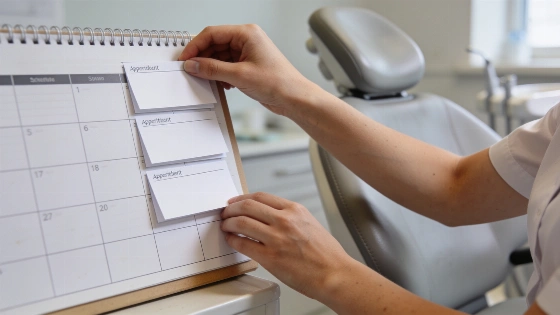
A year of appointment records might show that early Monday slots have roughly three times the no-show rate of afternoon appointments. A practice could use that signal to test a different reminder process or change how it offers those times. For a fair comparison, it should separate no-shows from late cancellations. A late cancellation may leave enough time to offer the slot to someone on a waiting list.
Dental clinics already hold treatment histories and appointment schedules. They also collect feedback from staff and patients. Data science can help practices find patterns in those records and make decisions based on evidence rather than impressions. The University of California, Berkeley described the process in 2023 as turning raw data into actionable insights. Appointment dashboards can track confirmations and waiting-list activity, then show chair utilization separately from attendance.
The useful starting point is a focused question: can the records answer it? A historical pattern may suggest a change worth testing, but it cannot establish what caused the pattern or guarantee that a proposed change will work. A practice-level analysis might compare appointment date and time with booking lead time. Previous attendance and treatment type can be examined as well. These relationships are associations to test, not causes proven by the records.
Where practice data can make a difference
Missed appointments leave chair time unused and can limit access for other patients. Scheduling records can show which factors track with attendance. These include booking lead time and previous attendance, as well as the day and time of the visit. Treatment type and appointment length may matter too. Seasonal trends are another factor to check. Tracking no-shows separately from late cancellations, then recording whether an empty slot was refilled, gives managers a clearer view of how gaps affect the practice.
If a practice's records show more missed early Monday appointments, managers could test extra confirmations or offer those times to patients with a reliable attendance history. They could also check whether staff contact a short-notice waiting list consistently after cancellations. This is an illustrative example, not a reported finding from a named clinic. The practice can compare results over a defined period, using consistent categories for attendance and cancellations. Confirmation records should use the same categories throughout.
Patient feedback adds another view of practice performance. Survey responses and online reviews may point to recurring concerns, including perceived waiting times or difficulty booking. Appointment feedback can reveal similar issues. Communication preferences can help a clinic compare whether patients respond more comfortably to text or email. Telephone responses can be assessed separately, rather than assuming one format suits everyone.
Demographic information may help guide decisions about the clinic environment or appointment availability. A practice serving many young families might consider children's educational materials. It could also look at appointment times that fit around school. A clinic serving older adults might assess accessibility, then review how readable its materials are. These are possible responses to local data, not universal prescriptions.
Patient experience also connects to the broader question of making routine care workable, explored in a report on GAOC. Feedback gathered by an individual practice can help identify which parts of the patient journey need attention locally.
Marketing records can show which channels are associated with new patient bookings and longer-term retention. Website traffic can add context, as can referral sources, particularly for specialty practices. A clinic might compare demographic patterns with treatment histories to assess interest in cosmetic dentistry. It could examine orthodontics separately. Commercial messages sent by text or email must comply with Canada's Anti-Spam Legislation, or CASL, including its consent requirements.
Staff records can be reviewed for scheduling and overtime patterns. Absenteeism can be examined alongside those figures, while continuing education participation and turnover offer other measures. Regular satisfaction surveys add employees' perspectives. If the records suggest frequent overtime is linked with burnout, managers could review schedules or onboarding practices. That link still needs further examination; the data alone does not prove cause.
A local workflow with privacy safeguards
In Ontario, the Personal Health Information Protection Act, or PHIPA, protects patient information. Equivalent legislation applies across Canada. The source article advises practices never to enter personal or identifying patient information, or confidential clinic financial information, into a large language model or another internet-based application. Analysis should happen locally on a password-protected office device.
A practice can export selected records to a CSV or Excel file and keep it on the office device. To request code from ChatGPT or Google Gemini, provide the analysis goal and column headers only. Microsoft Copilot can also be used for that request. Do not upload the data itself. Generic header names can reveal less about patients.
Python can run the analysis, with a code editor such as VS Code. The source workflow calls for installing the Python and Jupyter extensions in VS Code. It then has the user create a project folder and open a notebook file with the .ipynb extension. The data file stays in that folder, and the generated code runs locally.
A sample request could ask for Python code to examine cancellations and no-shows. The listed fields include appointment date and provider, plus treatment category and appointment length. Lead time and attendance status can be included too. The sample also uses patient age group. Practices can adapt the method to other questions by changing the goal and listing only the relevant column headers.
Code needs checking before its output guides a practice decision. The article recommends reviewing what each line does and asking an LLM to explain anything unclear. If the analysis cannot be explained, its result should not be used to justify an operational change.
The underlying records need scrutiny too. A pattern in a few hundred records may be noise. Incomplete or skewed historical data could also disadvantage a group of patients. Treat early findings as hypotheses to confirm, not conclusions to act on immediately. Publicly available practice datasets can help users learn the workflow before they work with a clinic's own records.