
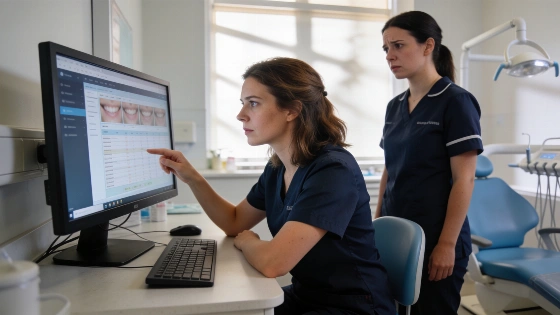
One overlooked AI-generated note in a dental record can trigger a cascade of clinical, legal and patient safety consequences. The stakes are no longer theoretical-artificial intelligence is already shaping how dental teams interpret radiographs, communicate with patients and manage records. Yet, the margin for error in healthcare is razor-thin. A convincing but incorrect AI output is not just a nuisance; it is a liability.
Hannah Burrow does not mince words: "AI should reduce friction without reducing clinical control." Her warning lands hard in an industry where the temptation to automate is strong, but the cost of a single mistake can be catastrophic. The question is not whether AI is good or bad, but whether a specific tool is fit for purpose-and what happens when it fails.
Before any dental practice hands over sensitive patient data or clinical decision-making to an algorithm, Burrow insists on a six-point interrogation. First, define the tool's purpose with surgical precision. Is it for radiograph analysis, patient messaging, or record-keeping? Know exactly what the AI will-and will not-do. Second, demand transparency about data: where does patient information go, how is it stored, and is it being used to train the system further?
Security and compliance are non-negotiable. Suppliers must provide hard evidence of clinical safety, cybersecurity protocols and regulatory status. If a vendor cannot show their homework-such as DCB0129 risk management, NHS DSPT, or MHRA registration-walk away. Clinical oversight is next: every AI-generated record must be reviewed and approved by a qualified clinician. Audit trails are essential; practices must be able to trace who created, modified and signed off on every output. Finally, the entire team must understand the tool's boundaries and proper use. Anything less is an invitation to disaster.
AI-powered note-taking deserves special scrutiny. The technology can hallucinate, inventing plausible details that never occurred, or omit critical context. Worse, automation bias creeps in: a polished, well-structured note looks trustworthy, making clinicians less likely to scrutinize it. Human review cannot become a box-ticking exercise. The clinician remains responsible for every diagnosis, consent, treatment decision and final record-no matter how slick the AI interface appears.
When comparing AI products, Burrow urges practices to focus on the unglamorous essentials: data protection, cybersecurity, clinical risk management, regulation and auditability. At Kiroku, she claims, these foundations are as important as the technology itself. Suppliers should make their compliance information easily accessible, ideally through a dedicated trust centre online. Anything less is a red flag.
AI is not going away. Used wisely, it can slash administrative burdens and free up clinicians to focus on patients, not paperwork. But the profession cannot afford to be dazzled by technical prowess alone. Dentists do not need to become engineers, but they must ask the right questions before entrusting patient care to algorithms. Anything less is professional negligence masquerading as innovation. For those ready to demand real answers, Kiroku's trust centre is a starting point: Kiroku's trust centre.