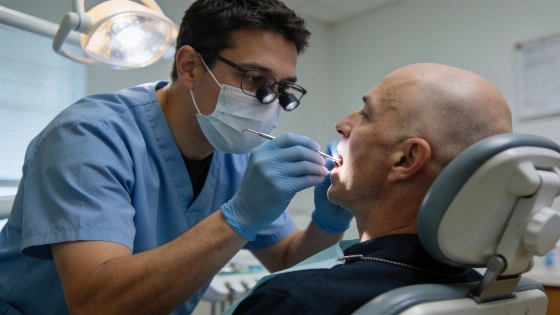
Professional periodontal maintenance had stopped after the patient's lymphoma recurred and his treatment changed. When he returned to care, teeth 16 and 38 were considered hopeless and needed extraction. Severe periodontal disease can destroy the bone supporting teeth. Extraction may be necessary when that support is substantially lost.
The patient, a man in his late fifties, was diagnosed with follicular lymphoma in 2017. His seven-year treatment course began with chemotherapy from July 2017 to August 2018. He received a stem cell transplant in September 2018. Further chemotherapy followed in 2024, then CAR T-cell therapy in December 2024. He remained under surveillance every three months and described his cancer care as seamless and fantastic.
His periodontal disease progressed despite his report that he kept brushing during treatment, including in hospital. Charting from 2019 to 2026 recorded attachment loss of at least 2 mm at multiple sites. The case report classified his condition as generalized Stage IV Grade C periodontitis, currently unstable.
Dental risks after cancer treatment
The authors identify the loss of professional periodontal maintenance as the leading modifiable contributor to the disease's progression. Care was first interrupted during the COVID-19 pandemic. It then lapsed through his 2024 recurrence and CAR T-cell treatment. His former smoking history was another risk factor. He was non-diabetic and reported consistent home care. Dental assessment before cancer therapy matters, as does regular oral-health follow-up during treatment and afterward. Poor oral health and existing gum disease can increase the likelihood or severity of oral mucositis. Dry mouth can contribute too. Dehydration and poor nutrition are also risk factors, according to Acibadem's oral-care guidance.
Other factors may have added to his oral risk. He reported dry mouth and altered taste, effects associated with chemotherapy and CAR T-cell lymphodepletion. Dry mouth can reduce saliva's natural cleansing and buffering functions. Supportive measures include gentle oral care. Keeping the mouth moist is also recommended. People undergoing cancer treatment are advised to drink water regularly when fluids are not restricted. He had stopped using toothpaste and brushed with water and salt instead, removing topical fluoride exposure. In late 2024, he adopted a diet based on frequent fruit consumption. The report describes its contribution as plausible, while noting that the diet was recent.
His caries risk was assessed as high.
Salivary flow was not measured, so the contribution of hyposalivation could not be quantified. The authors say sialometry would help distinguish a subjective feeling of dry mouth from an objectively reduced flow rate.
CAR T-cell therapy genetically engineers a patient's own T lymphocytes to recognize and attack tumour cells. It has become standard care for relapsed and refractory hematologic malignancy. Six FDA-approved products cover six indications. In follicular lymphoma, response rates in the ZUMA-5 and ELARA trials reached 94% and 86%. Long-term ZUMA-5 follow-up reported median progression-free survival of 40.2 months. More survivors are therefore likely to return to general dental practice after multiple lines of treatment.
Dental planning also has to account for blood counts. Cytopenia after CAR T-cell therapy may develop later and persist longer than after conventional transplant. Current guidance advises checking blood counts before invasive dental treatment during the relevant post-infusion period. The 2025 MASCC/ISOO statement was the first to address dental clearance before CAR-T explicitly.
For this patient, a complete blood count and absolute neutrophil count were within normal limits. Those results meant antibiotic prophylaxis was not required. The extractions proceeded after medical consultation. He had no history of bisphosphonate or denosumab exposure. He was not taking anticoagulants.
The report also cautions that a normal neutrophil count may not capture every infection risk. CD19-directed CAR T-cell therapy can cause prolonged B-cell aplasia and hypogammaglobulinemia. The authors say B-cell recovery could also be considered when assessing a patient before extraction. They include immunoglobulin G status in that assessment.
Care coordination and the dental home
The patient's lymphoma and transplant care took place through separate teams at a regional cancer centre. CAR-T surveillance followed. He said no one asked about oral health during that care. "Oral health 'never comes into play.'" He described medicine and dentistry as operating like separate dealerships. He said the system failed to work cohesively "to the detriment of us."
He had a general dentist but did not attend. His only dental care had been at the periodontal office two years earlier. When his treatment course intensified, the maintenance relationship was lost. The case reinforces why brushing alone cannot replace professional periodontal maintenance.
The broader access problem matters. Roughly a third of Canadians received no dental care in 2015. For a patient without an established dental home, an oncology referral may have nowhere to go. A 2026 scoping review of dental protocols across the cancer care pathway identified gaps in CAR-T survivorship pathways. It also found gaps in hematologic decision cutoffs. Referral triggers were another missing area.
Pre-transplant dental clearance is established practice, while the CAR-T equivalent is only beginning to receive explicit attention. In this case, teeth 16 and 38 were extracted after medical consultation and confirmation that the patient's blood counts were within normal limits.