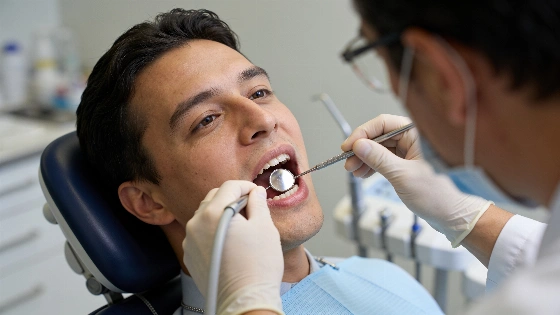
Clinicians first check whether a broken tooth has enough healthy structure to support a restoration. If it cannot be predictably saved, extraction becomes an option, and replacement is a separate decision.
A survey of 427 dentists published in the Journal of Dentistry found extraction recommendations rose from under 1% when the gums and bone around a cracked tooth were healthy to about 52% when periodontal involvement was severe. The figures describe dentists' recommendations across different clinical conditions. They do not establish one treatment rule for every cracked tooth.
A published review cited by Falko Family Dental reported long-term survival of about 94% for root-canal-treated, restored teeth and 96% for single implants at the final follow-up. These pooled figures are not a prediction for an individual cracked tooth.
Assessment comes before replacement
At Los Angeles Advanced Dentistry in West Hollywood, clinicians assess broken and failing teeth six days a week, including Saturdays. They check how much sound enamel and dentin remain, then assess how far the fracture extends. They also look for pulp involvement and examine the root. The gums and surrounding bone are assessed as well. Digital X-rays and 3D cone beam CT imaging can help show the condition of the root and bone.
Those findings shape the treatment. A crown, root canal treatment or another restoration may be appropriate. The American Association of Endodontists says a crack limited to a small portion of the tooth may be treated with a crown. If it reaches the pulp, root canal treatment and a crown may be needed. A crack extending below the gumline usually makes the tooth unrestorable. A vertical root fracture often leads to extraction because it can be associated with infection around the root. Root canal treatment does not correct that fracture, as described in Falko Family Dental's root-fracture treatment overview. The practice's preservation-first approach echoes a biology-first framework: treatment should reflect what the natural tooth can support, rather than a procedure the patient expected before the exam.
After extraction, implant placement may be immediate, early-about 4-8 weeks after soft-tissue healing-or delayed for several months. Significant bone loss, a need for bone grafting or medical considerations may lead the clinical team to wait for healing before placing an implant.
Same-day placement depends on the site
For qualifying patients, the practice can place an implant during the appointment when the failing tooth is extracted. The approach combines extraction and implant placement in one visit, but it does not suit everyone. Clinicians weigh bone condition and gum health. Infection and tooth location also matter. They assess whether the implant is stable after the extraction. Ridge Oral Surgery says immediate placement generally requires adequate bone and an intact cheek-side bone wall. Acute infection can rule it out, as can an abscess or pus. A clinical review summary cited by the practice reports survival rates of 92-100% for immediately placed implants. It also stresses careful patient selection and a suitable site.
If the site is not ready, clinicians can wait for the area to heal before placing the implant. "If the site isn't ready, we wait, and that's not a setback," Dr. Kashani said. "We let the area heal and place the implant a few months later. The result is the same implant. It just arrives on a different schedule." A permanent crown is fitted later, after the implant has fused with the jawbone.
The practice has an on-site dental laboratory where technicians fabricate and adjust crowns and other restorations. The dentist and technicians can assess shade and contour in person, then make adjustments on site.