One study reported peri-implantitis in 18% of patients enrolled in maintenance programmes, compared with 43.9% of those without maintenance. The gap is large, but it does not prove that maintenance caused the lower rate. Available independent search results did not substantiate this comparison, the IDRA recommendations or findings attributed to the 2025 AAP/AO review. Those specific claims should be checked against the underlying studies and guidance.
As implant volumes and provider networks expand, every placement brings a long-term maintenance commitment, as described in this market overview.
Standard steel instruments can scratch titanium implant surfaces and potentially increase plaque retention. Less abrasive or implant-specific instruments are recommended for professional cleaning.
Maintenance should follow risk
Supportive peri-implant care should match the patient's risk rather than follow a fixed recall schedule. Evidence associates individualized maintenance with improved probing depths and less bleeding on probing compared with fixed-interval or absent maintenance. For moderate- to high-risk patients, the guidance supports recalls every three to six months. Lower-risk patients may be seen at intervals of up to 12 months. The Implant Disease Risk Assessment (IDRA) tool can help clinicians structure that decision.
At each visit, clinicians should record six-point peri-implant probing and note bleeding or suppuration. They should assess plaque and remove biofilm. Home-care instructions also need reinforcement. A clinical review of implant instrumentation describes checking implant stability, with radiographs used when indicated.
A multicentre study involving more than 3,500 implants found significantly better implant survival among patients with previous periodontitis who attended supportive therapy. Its authors recommended two to three maintenance visits a year for high-risk individuals.
Commercial clinical guidance also lists bruxism, alongside smoking, diabetes and a history of periodontitis, as a reason to consider closer monitoring. The material does not provide a reliable quantitative estimate of the risk associated with these factors.
Decontamination has limits
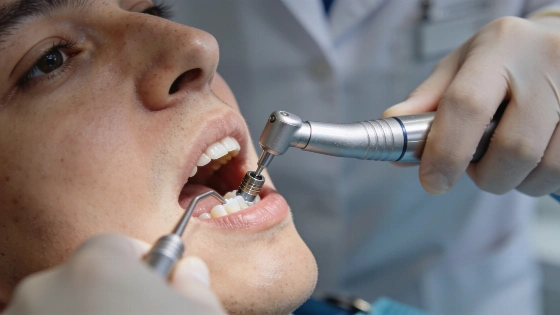
Air abrasion gives clinicians another option for removing biofilm. A 2025 American Academy of Periodontology/Academy of Osseointegration systematic review found air-powder abrasive devices among the strongest approaches for cleaning implant surfaces while causing minimal surface alteration. The review and related investigations support the use of glycine and erythritol powders.
In a randomized clinical trial in peri-implant mucositis, glycine air-abrasive debridement was followed by earlier and more sustained improvements in bleeding indices and probing depths than ultrasonic instrumentation. Significant improvements persisted for three months, compared with about three weeks after ultrasonic therapy. In vitro research found less residual biofilm with erythritol powder than with PEEK ultrasonic tips or titanium curettes, with minimal surface damage.
That evidence does not establish air polishing as a stand-alone treatment for established peri-implantitis. The European Federation of Periodontology (EFP) S3 Clinical Practice Guideline says evidence is insufficient to recommend submarginal air polishing as nonsurgical monotherapy for the disease.
Prevention starts in the treatment plan
Before placement, clinicians should assess risk and treat periodontitis to a stable endpoint. They should support smoking cessation and optimize glycemic control. The EFP guideline also recommends supportive periodontal care before implant surgery. Prosthetic contours need careful planning: patients must be able to clean effectively, and clinicians must be able to probe and debride. Plaque-retentive emergence profiles should be addressed during planning.
Home care remains essential. Patients should brush twice daily and use suitable interdental cleaning. Interdental brushes may help with complex prosthetic designs. Specialty floss is another option. Water irrigators may also help patients manage these designs.