
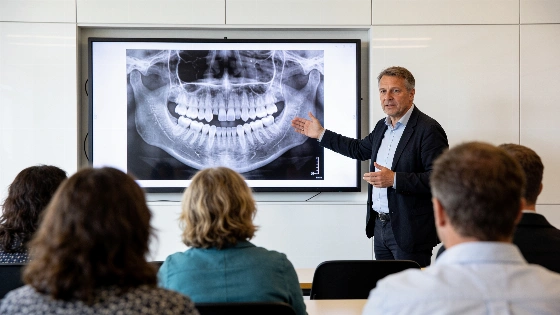
For people who have lost both teeth and jawbone, the chance to eat, speak, and smile comfortably again is becoming more realistic. Professor Jonas Becktor is leading research in jawbone reconstruction, with a focus on helping patients regain both function and appearance after major oral tissue loss.
Segmental mandibulectomy, a procedure where a portion of the lower jaw is removed due to deep tumor invasion, typically requires subsequent reconstruction to restore jaw function and appearance.
This research is not just about looks. By reconstructing the jawbone, Becktor aims to restore basic abilities like chewing, speaking, and facial support, while also improving how patients look. Addressing both function and aesthetics is a key part of his work in oral surgery.
At Professor Becktor's inaugural lecture, attendees will hear about these findings directly. The event will be held in Swedish and will include refreshments, reflecting the value of community and shared learning in dental science.
In clinical practice, jaw reconstruction often involves not only bone grafting but also microvascular techniques, where blood vessels from the graft are connected to neck vessels to ensure tissue viability. This approach is considered a standard, not experimental, method in modern maxillofacial surgery.
The FDA classifies bone graft materials as implantable devices for repairing and rebuilding oral and facial bone, including damage from trauma, tooth loss, or preparation for dental implants. These materials are officially recognized for use in oral and maxillofacial reconstruction, highlighting the medical and regulatory importance of jawbone restoration.
In related practice, orthognathic surgery is used to correct jaw function when orthodontics alone is not enough. According to a private clinical review, surgery on the upper and lower jaws is standard for treating bite problems, facial asymmetry, and related functional issues, showing the range of surgical options for complex jaw conditions.