
Laxmi Dental began FY27 with quarterly profit growth of 23.8%, while Prevest DenPro reported growth of 28%. Neither company had borrowings. India's dental consumables market is projected to reach USD 3.63 billion by 2033.
Laxmi Dental's 3Q FY26 EPS fell to ₹0.37 from ₹0.88 a year earlier. Revenue still increased 11% year on year to ₹681.2 million, while net profit declined 59% to ₹19.8 million.
Two businesses serving different parts of the dental chain
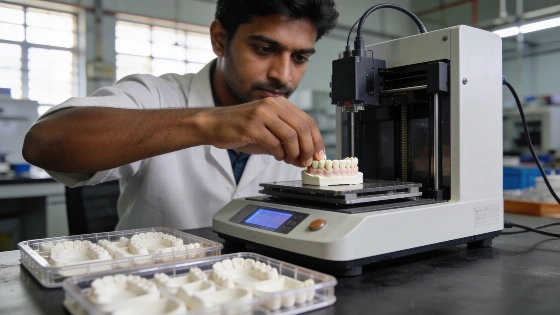
Laxmi Dental works across dental laboratory solutions, aligners, and paediatric dental products. Its Illusion Dental Lab business makes customised prostheses such as crowns and bridges. Illusion Aligners and Taglus supply orthodontic products, including thermoforming sheets, 3D printing resins, machines, and accessories. Kids-e-Dental serves more than 15 countries.
Prevest DenPro follows a different model. It makes dental consumables such as adhesives, bonding agents, etchants, cements, composites, endodontic products, and finishing materials. Its Prevest Research Institute was established in 2020. The institute works on dental biomaterials, product characterisation, clinical evaluation, clinical investigation, and patient safety.
Laxmi is more exposed to patient-specific laboratory and aligner economics. Prevest depends more on product volumes, distribution, manufacturing efficiency, and research productivity.
The market is already sizeable. Grand View Research estimates India's dental equipment and consumables market at USD 2.09 billion in 2024. It projects the market will reach USD 3.62 billion by 2030. Dental consumables were the largest product segment in 2024.
Laxmi Dental's 22nd annual general meeting on 25 September 2026 approved all four resolutions, including the FY26 financial statements and a change to the permitted use of IPO proceeds. The special resolution received 99.9984% approval from participating shareholders.
Full-year figures show why revenue growth needs closer scrutiny. Simply Wall St reported FY26 revenue of ₹2.86 billion for Laxmi Dental, up 20% from FY25. Net profit fell 11% to ₹289.8 million.
The business is growing its top line. It is still struggling to turn that growth into earnings.
Laxmi's growth is increasingly tied to higher-margin businesses
Laxmi reported Q1 FY27 revenue of ₹74.70 crore, up 13.9% year on year. EBITDA rose 20.6% to ₹14.36 crore. PAT after the share of profit or loss from joint ventures increased 23.8% to ₹10.32 crore. PAT margin improved to 13.8% from 12.7% a year earlier.
The sales mix tells more of the story. Laboratory revenue reached ₹50.28 crore. Laboratory revenue excluding scanner sales grew 23.5%. International laboratory operations increased 37.4%.
Aligner Solutions revenue rose to ₹24.17 crore from ₹18.73 crore. Its segment result climbed to ₹6.53 crore from ₹2.28 crore. Bizdent grew 27.8% during the quarter, while Vedia grew 29.3%.
Scanner revenue fell to ₹2.2 crore from ₹5.9 crore a year earlier. Management describes scanners as a strategic tool for digital dentistry rather than just a hardware product. The test is simple: does scanner use create more laboratory and aligner work over time?
Scanners carry lower margins than laboratory and aligner activities. Their lower contribution helped lift gross margin to 78.6%.
Palghar is the next major test. Laxmi is moving towards an owned manufacturing facility in Maharashtra. It is also adding three support facilities in India. The investment could improve control over automation, manufacturing, and operating costs. That depends on commissioning, utilisation, and additional revenue.
Execution matters. Revenue rose from ₹137 crore in FY22 to ₹278 crore in FY26. Operating profit increased from ₹7 crore to ₹44 crore.
Yet FY26 revenue grew from ₹239 crore to ₹278 crore, while operating profit rose by only ₹1 crore. Net profit fell from ₹32 crore to ₹29 crore. Growth without operating leverage will not justify a premium valuation.
Prevest offers steadier manufacturing economics with new bets
Prevest generated Q1 FY27 revenue of ₹19.07 crore, up 20.94% year on year. EBITDA increased 24.73% to ₹8.08 crore. PAT rose 27.99% to ₹5.64 crore, although it fell 3.14% sequentially.
Consolidated expenses increased only 2.30% quarter on quarter to ₹12.82 crore. Material consumption rose to ₹4.80 crore from ₹3.76 crore.
Its five-year figures show a steadier profit engine. Sales increased from ₹38 crore in FY22 to ₹72 crore in FY26. Operating profit moved from ₹15 crore to ₹26 crore. Net profit rose from ₹12 crore to ₹21 crore.
Prevest reports one operating segment under AS 17. Investors therefore cannot assess performance through separate business-line disclosures.
The company is also building a possible recurring revenue channel around 3D printing. FY26 commentary reported 3D printer sales growth of 162% and 3D printing resin growth of 40.5%. Prevest is working towards a fully indigenous 3D printer by 2028.
It has commercialised its disinfectant business. The company plans two or three new Oradox products in FY27. The printer strategy will work only if commercial adoption creates sustained demand for resins and related consumables.
Debt-free balance sheets give both companies room to act. They do not remove financial risk.
Prevest had cash and cash equivalents of ₹72.65 crore as of 31 March 2026, compared with ₹60.46 crore a year earlier. FY26 operating cash flow was ₹15.86 crore against net profit of ₹21 crore.
Aggregated financial data also indicated positive FY26 operating cash flow of 148.09. It reported net profit of 204.91. Investors should reconcile both figures with the company's formal financial statements before relying on them.
Prevest said its trading window would close from 1 October 2026 ahead of the unaudited results for the quarter and half-year ended 30 September 2026. The window is expected to reopen 48 hours after the results are disclosed. That announcement is a near-term information point for investors.
Laxmi had nil consolidated borrowings as of 31 March 2026. It repaid its remaining term loan during FY26.
Expansion still requires capital for machinery, facilities, digital systems, and international operations. Free cash flow after investment spending will matter. So will the return on new capacity.
Exports create scale and concentration risk
Laxmi serves more than 22,000 dental clinics, dental companies, and dentists across over 320 Indian cities. It exports to more than 95 countries. FY26 export revenue for custom-made prostheses, aligners, and allied products stood at ₹96.54 crore.
Earlier disclosures placed India at 68% of revenue, the US at 19%, the UK at 7%, and other markets at 6% in H1 FY25. US tariff uncertainty has affected management commentary before.
Prevest sells in more than 90 countries. Europe accounted for 49% of FY25 revenue, followed by Asia at 27% and the Middle East at 18%.
The company uses Axiodent Inc in the US and Prevest DenPro Gulf General Trading LLC in the UAE to expand distribution. Management reported US business growth of 37.58% in FY26, helped by Axiodent and private label activity. UAE operations were delayed by geopolitical disruption.
The move toward digital production also connects this story to the wider technology market covered in an earlier market report. The question for these companies is not simply whether digital dentistry expands. Equipment adoption must produce profitable laboratory orders, materials demand, and repeat consumables sales.
Manufacturing brings other pressure points. Polymers, resins, ceramics, metals, acrylics, and chemicals can push up costs through input prices and currency movements.
Laxmi's raw material purchases increased to ₹51.15 crore in FY26 from ₹37.25 crore in FY25. Higher volumes also raise the risk of remakes, rejected products, and delays. Patient-specific production must maintain quality and turnaround times.
Laxmi traded at ₹193.87 on 1 October 2026. Its PE ratio was 30.67. The stock had risen around 13% over six months but remained down around 27.5% year to date.
Motilal Oswal maintained a Buy rating with a ₹280 target. It said Q1 FY27 EBITDA and PAT beat estimates by 11% and 14%.
Prevest traded around ₹377.05 with a trailing PE of about 21 times. It had gained more than 4.5% over six months but remained down more than 23% in 2026. No recent brokerage rating was reported for Prevest.
These shares belong on a watchlist, not an automatic buy basket. The dental opportunity is real. Both companies delivered strong quarterly profit growth without debt.
The investment case will depend on cash conversion, capacity utilisation, export resilience, and margins. Laxmi must show that Palghar and aligner growth can repair the operating leverage weakness visible in FY26. Prevest must show that 3D printing and new products can grow without weakening its steadier profit engine.
The sector deserves attention. The stocks still need evidence.
This article is educational and not investment advice. Data was relied on from Screener.in where available. Readers should consult an independent adviser before making investment decisions. The writer and dependents do not hold the stocks discussed.