
Researchers found 158 operations among tobacco users in one matched insurance group, compared with 98 in the group without a recorded tobacco use disorder. The result points to an association, not proof that tobacco caused the tendon condition or made surgery necessary.
Ernesto Joubran and colleagues examined approximately eight million patient records for the study, which appeared in Scientific Reports under the title "Exploring the link between comorbidities, tobacco usage, and surgical intervention in medial epicondylitis." The study's other main finding was much smaller: recorded tobacco use was linked to about 5% higher odds of a golfer's elbow diagnosis.
A 2018 systematic review covered 243 studies and found predominantly unfavorable associations between smoking and musculoskeletal health, including effects involving muscles, tendons, cartilage and ligaments. The authors said that the mechanisms involved and the effects of quitting smoking require further study.
What the claims data showed
The researchers used Humana insurance claims stored in the PearlDiver database from 2007 to 2015. They identified 23,573 patients with golfer's elbow, also known as medial epicondylitis. That group made up approximately 0.29% of the database population.
For the tobacco analysis, the team matched 1,657,810 patients with a recorded tobacco use disorder to the same number without that diagnosis. The matching factors were age, sex, alcohol use, diabetes, high cholesterol, high blood pressure and obesity.
Golfer's elbow appeared in 5,584 tobacco users, or 0.34%, compared with 5,300 people without a recorded tobacco use disorder, or 0.32%. The odds ratio was 1.05. That is a modest association, and it does not show that tobacco exposure directly produces medial epicondylitis.
The broader orthopedic literature links smoking with poorer blood supply and less favorable tissue healing, but that general context does not establish that tobacco causes medial epicondylitis or makes surgery necessary for it. The 2018 review addressed a wide range of musculoskeletal diseases and outcomes rather than this specific insurance analysis.
The surgery comparison was stronger.
Among the full matched groups, 158 tobacco users underwent an operation associated with golfer's elbow, compared with 98 patients in the comparison group. The reported odds ratio was 1.62, with a 95% confidence interval of 1.25-2.08.
Within the patients who had a recorded golfer's elbow diagnosis, surgery occurred in 2.83% of tobacco users and 1.85% of patients without a recorded tobacco use disorder. Across the full golfer's elbow population, 525 patients underwent surgery, or 2.23%.
A condition often mistaken for a sports injury
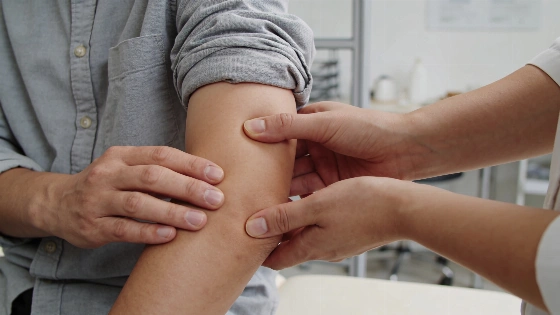
Medial epicondylitis affects the tendon that connects several forearm muscles to the inside of the elbow. Those muscles support wrist movement and gripping. Repeated bending, twisting and forceful hand activity can strain the tendon. Small repeated injuries may change its collagen structure and contribute to thickening, scar tissue and pain during work or everyday tasks.
Despite its name, golfer's elbow is not mainly a golfing problem. The paper says more than 90% of cases are unrelated to sport. Repetitive work accounts for much of the burden. Golf, tennis, baseball and throwing can strain the tendon, but the same movements affect people whose jobs require frequent gripping or wrist movement.
Patients aged 60-69 made up the largest age group among those diagnosed, at 25.64%. People aged 50-59 accounted for 23.08%, while those aged 40-49 accounted for 17.26%. Together, patients aged 40-69 represented roughly two-thirds of recorded cases. Men accounted for 52.46% of diagnoses.
Other conditions also appeared often in the golfer's elbow group. High blood pressure occurred in 58.66% of patients, high cholesterol in 56.98%, diabetes in 26.22%, tobacco use disorder in 23.69%, obesity in 16.57% and alcohol abuse in 2.93%. These figures describe what appeared alongside the diagnosis in the claims data. They do not show what caused it.
Surgery remained uncommon, and the trend data are limited
Patients aged 50-59 made up the largest share of operations, at 36.57%. Those aged 40-49 accounted for 28.57%, followed by patients aged 60-69 at 17.90%.
Recorded tobacco use appeared more often among surgical patients than among all patients with golfer's elbow: 30.10% compared with 23.69%. High blood pressure was less common among surgical patients, at 50.48% compared with 58.66%. Differences involving diabetes, high cholesterol, obesity and alcohol abuse did not reach statistical significance.
These surgical comparisons were descriptive. The surgical patients came from the larger group used for comparison, and the researchers did not adjust for multiple differences between the groups.
Annual recorded golfer's elbow diagnoses increased 103% between 2007 and 2015. Codes for elbow tendon-release and tissue-removal procedures rose 348%. Both counts peaked in 2014.
Those procedure codes also cover other forms of epicondylitis, so they cannot provide a clean count of golfer's elbow surgery. Coding changes and missing records may have contributed to the small decline in 2015.
The database did not identify the tobacco product, the amount or duration of exposure, or whether a patient had stopped using tobacco. Undocumented tobacco use may also have put exposed patients in the comparison group.
The analysis did not account for occupation, sports participation or socioeconomic circumstances. The records also could not reliably establish which elbow was affected, whether earlier treatments had failed or how patients recovered after surgery.
The available search did not identify independent verification of later clinical recommendations, an official author response, a correction or a confirming study for this specific paper. The broader review concerns musculoskeletal health in general. It does not establish that tobacco causes medial epicondylitis or raises the likelihood of surgery for it.
The study offers a signal rather than a clinical rule. Its stronger association involved a relatively uncommon outcome, while its weaker association involved the diagnosis itself.
For dentists and other clinicians reviewing tobacco history, the result is observational evidence that needs context. It does not prove that tobacco determines who develops golfer's elbow or who needs an operation. The millions of records show a pattern, but the study's limits prevent causal claims or treatment changes based on the findings alone.