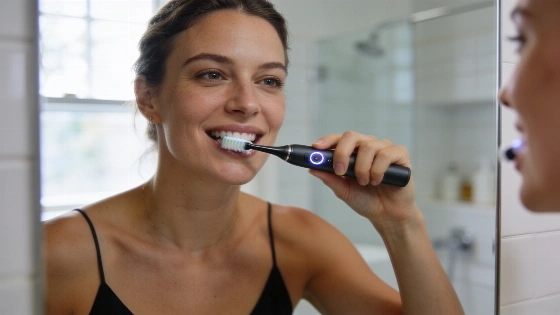
Amazon lists Philips Sonicare's Next-Generation DiamondClean 9900 Prestige at $379.99. Its main new feature is an on-device mouth map that shows missed areas during brushing. Royal Philips calls it the company's most advanced and intelligent toothbrush to date.
The device is described in an industry review as using a 12-segment mouth map alongside SenseIQ and real-time coverage feedback.
Brushing feedback without a phone
Philips says the toothbrush uses its third-generation AI and machine learning technology to track brushing and guide users through indicators on the handle. The system shows which areas are clean and which are not. Users do not need an app.
That matters during the bedtime rush. Philips Sonicare's Distracted Nighttime Brushing Study was conducted in May 2026. It found that 82% of surveyed Americans multitask during nighttime routines. The figure rose to 92% among adults under 40.
Nearly half, or 47%, said they rush brushing as a result. Another 66% said they miss areas. Yet 91% said their teeth feel clean afterward.
The figures show a gap in perception, not a clinical diagnosis. They also explain why Philips puts coverage feedback on the handle. Users can see the result during the routine instead of trying to judge it later.
The point is simple.
Philips lists up to 100% more stain removal in less than two days among the Next-Generation Sonicare claims. The company's professional product page also marks the launch as coming in September 2026.
"People should feel confident that their toothbrush helps them achieve a great clean every time, especially given the established connection between oral health and overall health", said Matina Vidalis, Regional Business Unit Leader, Oral Healthcare, Philips Personal Health North America. "Grounded in more than 50 years of oral care expertise and clinical heritage, our Next-Generation DiamondClean brings highly intuitive coaching directly to the handle. Its Smart Mouth Map and light indicators guide users as they brush, helping them see and address missed spots in real time without an app, in a design that reflects the premium craftsmanship people expect from Philips Sonicare."
Performance claims and portfolio pricing
Philips states that the Next-Generation DiamondClean 9900 Prestige removes 2000% more plaque than a manual toothbrush with an A3 brush head. It also delivers 1500% healthier gums than a manual toothbrush in six weeks.
Its Sonicare Fluid Action is designed to support the bristles by driving fluid between teeth and along the gumline. Philips' official product information also lists up to 20 times more effective plaque removal, up to 15 times healthier gums and up to 100% more stain removal. The comparison and test conditions differ.
These are manufacturer claims. They should be read alongside the company's user testing, not treated as independent clinical evidence. In a Sonicare USA user-testing study of 153 participants after two weeks, 85% agreed that the toothbrush helped improve their brushing. Another 92% agreed that Smart Coverage Feedback increased awareness of cleaned and uncleaned areas.
The 9900 Prestige has an interactive display, eight modes and three intensities. It comes in Silver White, Onyx Black and Satin Mauve.
Philips also sells the Next-Generation DiamondClean 8500 on Amazon for $249.99. That model has six modes and three intensities. Its colors are Powder White, Black and Blossom Pink.
Both models include a rechargeable travel case and charging glass. Their packaging uses paper-based materials. Philips says the brush heads are made with 70% bio-based plastic on a mass balance basis.
The wider 2026 portfolio refresh also includes new 5000 to 7000 Series models.
That is the broader market.
Philips is competing for attention in online oral-care shopping. An earlier market analysis identified online buying and alternative materials as forces reshaping the dental floss category.
For patients, the main change is not simply a higher price or more brushing modes. Philips is trying to turn coverage into feedback at the moment of use.
Removing the phone makes that approach easier to use. The performance figures still come from Philips, and the user test lasted only two weeks.
The product looks like a substantial usability step in smart toothbrush design. It is not proof that digital coaching alone produces better long-term oral-health outcomes.