On October 2, 2026, medical and dental professionals gathered at the Muhammad Dental College (MDC) campus in Mirpurkhas to examine what artificial intelligence can and cannot do in dentistry.
The event was Ibn-e-Sina University's 28th International Annual Medical Symposium. Its theme was "The Advent of AI: Dawn of Humanization or Dehumanization." Researchers, academics, faculty members and students joined the programme.
The Islamabad AI Declaration is described as a nine-principle framework for responsible, nationally capable AI development. Its specific enforcement mechanisms were still being developed in the material reviewed.
AI met the realities of clinical practice
The scientific speakers' session moved past broad predictions about digital healthcare. Dr. Fahad Umer, Founder of MeDentec, examined artificial intelligence in diagnosis and its current capabilities in dentistry. He focused on the way AI is beginning to shape diagnostic approaches and clinical decisions.
Dr. Salman Shafique took the discussion into oral and maxillofacial surgery. His presentation, "AI vs Human Intelligence in an Oral and Maxillofacial Surgery (OMFS) Landscape," drew on difficult professional and surgical experiences.
His focus was not simple replacement. He considered how AI may work alongside clinical expertise in complex surgical practice.
Pakistan's National CERT warning published on October 3, 2026 concerned organisations' use of shadow AI; it did not verify the symposium's speakers, participants or decisions. Independent results reviewed for this report also contained no official programme, proceedings record or university statement confirming those details.
The emphasis on technology and patient-centred care also connects with earlier reporting on dentistry's prevention-led future. The Mirpurkhas programme took a different form. It brought debate, training and student development into one institutional event.
Pakistan's wider AI policy timeline formed part of that discussion. An industry review says the federal cabinet approved the National AI Policy in July 2025. The Islamabad AI Declaration was adopted at the Indus AI Summit in February 2026.
A review of Pakistan's AI framework describes those measures as general governance principles. They are not dental-specific rules.
Hands-on dentistry anchored the programme
Clinical training ran beside the main proceedings. Final-year BDS students and dental graduates joined "Clear Path," an advanced orthodontic and aligner session led by Dr. Muhammad Uzair of Baqai Dental College.
The session tied the AI discussion to current orthodontic workflows. Students worked with the practical side of the profession.
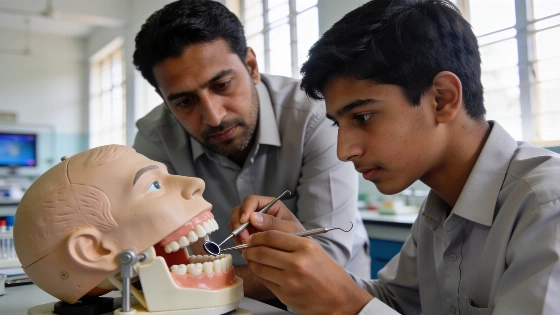
At the MDC Phantom Lab, Prof. Dr. Amir Mehmood Butt, Professor and Chairman, Department of Prosthodontics, LUMHS, led a hands-on session for third- and final-year BDS students. The subject was the application of veneers.
Prof. Dr. Abrar of Hamdard Dental College led an intensive workshop on modern endodontic rotary systems. More than 50 participants from Muhammad Dental College, BDMC and Isra Dental College attended that workshop.
Dr. Ali Maqbool Khuwaja held a separate seminar on medical education for faculty members and early-career dental students. Teaching practice stayed in the programme.
The format was clear. Students discussed emerging tools beside the manual skills, teaching methods and treatment techniques they still need to learn.
Students confronted the profession beyond the clinic
At midday, the focus moved from instruments and algorithms to professional identity. Final-year BDS students Memoona Siraj and Sayeda Urooj Fatima moderated "Beyond the White Coat: The Dentist, the Career and the Future" at the Mrs. Razia Ali Auditorium.
Dr. Jazib Memon, Dr. Sarang Suresh, Dr. Nida Talpur and Dr. Sana Mirza discussed clinical entrepreneurship, digital transformation, healthcare bioethics and the effect of artificial intelligence on future career pathways.
Career planning was treated as part of technological change. Graduates will have to make choices about entrepreneurship, ethics and the limits of professional practice.
Students also handled work behind the scenes. Final-year BDS and MBBS students supported registrations, presentations, invited speakers, workshops and on-ground arrangements. They worked with faculty members and event teams.
That work gave them direct responsibility for leadership, teamwork and event organisation during a major academic programme.
University leaders, faculty members, visiting academics and students coordinated the event through the Scientific Committee, focal persons, faculty coordinators and student teams. The opening ceremony brought together Prof. Dr. Shamsul Arfeen, Pro-Chancellor, ISUM; Prof. Dr. Zafar H. Tanveer, Vice-Chancellor, ISUM; Prof. Dr. Qadeer ul Hassan, Dean, MDC; Prof. Dr. Noor Ahmed Khoso, Principal, MDC; Prof. Dr. Farzana Majeed, Director Research & CAO, ISUM; Dr. Parmanand Das, Associate Dean, MDC; and Dr. Doha Rajar, Assistant Research Director, ISUM.
The inaugural proceedings ended with souvenirs for invited speakers and guests. A formal vote of thanks followed.
The event did not promise that AI would solve dentistry's problems. It examined the technology beside hands-on care, education, ethics and career development. That is the useful standard: trained clinicians must apply tools responsibly, while human judgment remains accountable for patient care.
The reviewed results did not identify a Pakistan Medical and Dental Council decision, separate regulation or published clinical standard specifically governing AI in dental diagnosis, surgery or treatment decisions.
No independently verifiable direct statements from Dr. Fahad Umer, Dr. Salman Shafique, Dr. Syed Muhammad Faizan, Ibn-e-Sina University or Muhammad Dental College about the symposium's outcome were located.