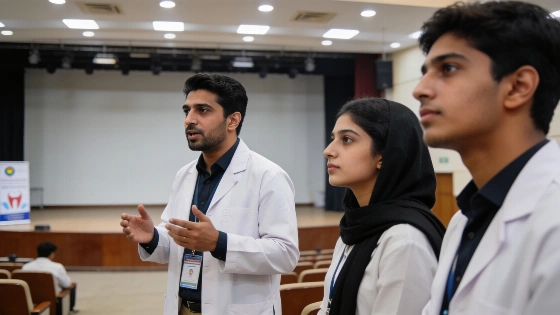
At Jinnah Auditorium in Islamabad, students and young dentists met professionals who had built careers in clinical practice, education, specialist dentistry, public health and digital communication.
Pakistan's PM&DC approved 1,400 seats in public-sector medical and dental colleges and said public and private institutions must meet unified standards for education quality, clinical infrastructure and patient safety.
Career journeys replaced conventional lectures
The digital dentistry segment began with TED-style talks instead of standard academic presentations. Dr. Syed M. Faizan spoke about a career that spans implantology, dental education and leadership at Vanguard Dental School. Dr. Asfand Ali Khan shared the view of a consultant endodontist and Clinical Director at Scope Dental Practice. Dr. Abu Bakr discussed Oral and Maxillofacial Surgery alongside his online presence in the dental community.
Dr. Haroon Shah spoke about the overlap between implantology, cosmetic dentistry and digital patient education. Dr. Syeda Urooj described work that combines dentistry with digital content creation, lifestyle and fashion. Dr. G.M. Paracha brought a public-health view after earning a degree in Epidemiology from the Johns Hopkins Bloomberg School of Public Health in 2025. He was named Bloomberg Student of the Year 2025.
Each speaker had five minutes. They explained how their career started, which choices shaped it and which problems they had to handle. The format showed the uncertainty behind professional success.
PM&DC's NRE Step-I, part of the registration process for Pakistani medical and dental graduates trained abroad, was rescheduled for 8 November 2026. The examination remains relevant even after MDCAT was removed as a prerequisite for Pakistanis entering medical or dental programmes overseas.
Research gave students a place in the programme
The academic session included first-year dental students from Foundation University College of Dentistry and Riphah International University College of Dentistry. Their presentations examined newer questions with possible value for future research and clinical work.
Dr. Nauman Bari Khan, Professor and Vice Principal at Margalla Institute of Health Sciences, and Muhammad Azhar, Assistant Professor and Head of the Department of Oral Biology at Army Medical College, judged the presentations. Foundation University students won first prize.
Hamna Changez presented "Deciduous Autologous Tooth Stem Cell Regeneration." Fatima Fahad presented "Integrating Metatranscriptomics for Peri-implantitis Diagnosis."
The winning topics covered different ground. One looked at regenerative work involving dental stem cells. The other examined metatranscriptomics as a way to understand peri-implant disease. The summit did not present either project as an established clinical solution. It gave both projects a formal place beside the career sessions.
Networking became part of the learning
During the panel, students and young dentists asked about career development, postgraduate training, networking and professional identity. Speakers returned to the need to find a niche, work consistently, stay humble and keep learning. They also described collaboration and professional visibility as practical parts of dental work.
The meet-and-greet took those discussions outside the auditorium setting. Students approached the invited professionals, asked for advice and discussed their plans in a less formal space. An earlier report also looked at how digital dentistry education can connect trainees with new technical workflows. The Foundation University summit focused more closely on career identity and mentorship.
Dr. Ammar Abdullah, Head of the Department of Oral Biology at Foundation University College of Dentistry, conceived the summit. He developed the idea with his team over several months. The organisers arranged the academic programme, invited speakers and set up the informal sessions.
The closing awards and certificates recognised the organisers and team members who made the event work. That part of the programme carried its own message. Professional opportunities depend on leadership and coordination as well as personal branding.
Foundation University's programme offered a direct view of changing dental careers. Clinical expertise remains the base. Research, communication, networking and digital engagement now affect how young professionals learn and gain attention in the field.
The summit also placed those career questions within Pakistan's regulatory system. A PM&DC seat decision report said the regulator tied college recognition to suitable educational and clinical resources and patient protection. Visibility has less value without credible training and safe practice.
For students considering education outside Pakistan, the licensing route remains important. MDCAT is no longer required for Pakistanis applying to overseas medical and dental programmes. That change does not remove the later licensing requirement. Under Section 18 of the PM&DC law, graduates seeking full registration must still pass the National Registration Examination, according to a registration policy report.
PM&DC also rescheduled NRE Step-I for 8 November 2026. The exam forms part of the registration process for Pakistani medical and dental graduates trained abroad. The rule gives the summit's message about mentorship and career planning a wider setting. Skills must eventually be documented and recognised.