Thirty dental professionals and trainees took part in a one-day workshop on clear aligner planning and fabrication at Fatima Memorial College of Dentistry.
A publicly available profile of a doctor associated with FMH College of Medicine & Dentistry notes certification in clear aligner treatment. That indicates relevant clinical expertise, but does not by itself confirm a local aligner laboratory or manufacturing cycle.
The reported model brings diagnosis, intraoral scanning, digital treatment design, case refinement and 3D-printed appliance production into one institutional workflow.
Training built around the complete digital workflow
The available public profile links FMH College of Medicine & Dentistry with dental education and clinical services and records clear aligner treatment certification for an associated clinician. It does not provide an official statement confirming the reported in-house fabrication launch, equipment commissioning date or laboratory capacity.
Participants also examined when aligner-only treatment may be suitable. They discussed when more complex cases may need hybrid orthodontic mechanics.
They were guided through intraoral scanning and the transfer of STL files into digital treatment-planning software. The digital model then becomes the basis for treatment design.
Planned tooth movements can be sequenced before appliance manufacture. The process links the patient's clinical information to production instead of treating planning and fabrication as separate tasks.
From digital planning to 3D-printed appliances
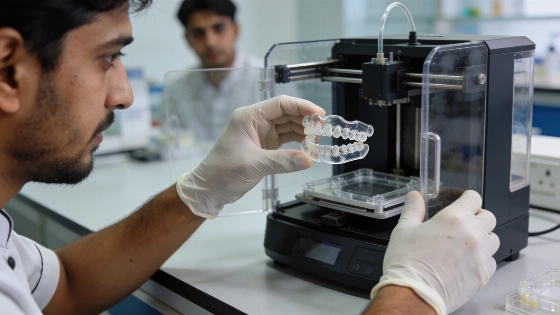
The manufacturing session took place at the newly established digital laboratory at Fatima Memorial Hospital. Participants observed advanced digital equipment and a live demonstration of 3D printing for planned orthodontic cases.
Publicly available material does not provide independently confirmed figures for the laboratory's output, budget or equipment commissioning.
Associate Professor Dr Mariyam Masood, Dr Tahreem Zahid, Dr Saba Sikandar and Dr Muhammad Uzair supported the practical teaching with residents from the Department of Orthodontics. The programme paired faculty instruction with direct exposure to digital processes that trainees are increasingly expected to understand.
Professor Dr Abid Ashar, Principal, and Dr Mohsin Dewan, Administrator, have described a broader digital direction for the institution. The programme also fits a wider professional shift towards digital impressions, three-dimensional treatment planning, computer-assisted workflows and additive manufacturing in orthodontic care.
A related earlier workflow in implant dentistry shows a similar link between diagnosis and later treatment stages.
Planned expansion beyond institutional patients
Fatima Memorial College of Dentistry says the in-house service will first support its own patients. It may later create opportunities to serve dental practitioners across Pakistan.
That is a stated objective, not an established national service. No independently verified rollout schedule or service volume was available.
The clinical value of the model will depend on more than the appliance. Clear aligner therapy still requires appropriate diagnosis, case selection, treatment planning, monitoring and refinement, even when an institutional digital laboratory makes the appliance.
The college has presented digital orthodontics as a practical training discipline. Education and fabrication now sit in the same reported environment.
The final status remains provisional. A direct confirmation from the college, its orthodontics department or Fatima Memorial Hospital has not yet been published.