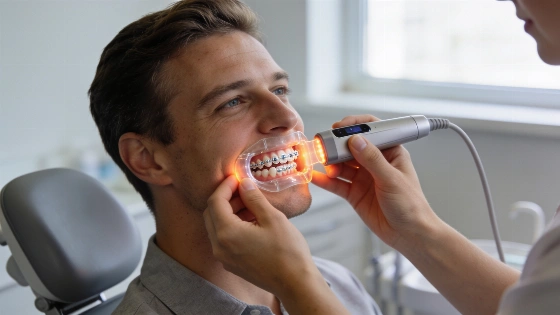
A preliminary clinical evaluation from Biolux Technology claims that the OrthoPulse near-infrared light therapy system cut average Invisalign treatment time by 55%. It also reported 21% fewer office visits.
The result has not been independently verified. Biolux disclosed it in its own release, and no outside confirmation was identified. Still, the figures show where September's product activity is focused: diagnosis, treatment monitoring, patient troubleshooting and routine office work.
DEXIS says Motion Correction for its OP 3D LX and EX systems is delivered through a software or firmware update, so practices can add the capability without purchasing new imaging hardware.
DEXIS is working on several chairside problems. Between September 23 and 28, the company disclosed updates for its imaging and scanning platforms.
The changes add Motion Correction to OP 3D LX and EX CBCT units. They also introduce a slim tip for the Impevo scanner and expand the DEXIS IOS Cloud platform. The stated goal is practical: reduce problems caused by patient movement and make difficult anatomies easier to scan.
Practices do not need to replace existing imaging equipment for Motion Correction. DEXIS describes the feature as a software or firmware update.
Orca Dental AI and Planet DDS are moving imaging into practice software. On September 28, the companies announced a partnership that integrated the CephX AI imaging suite with Cloud 9.
Clinicians can use real-time cephalometric analysis inside the workflow. The integration also includes DICOM and intraoral-scanning tools, plus immediate cloud-based radiographic reports. The companies described automated 2D and 3D imaging and multi-location oversight for orthodontic practices and DSOs.
The DEXIS IOS Cloud update gives the platform a new interface and connects it with 3Shape for data exchange between clinicians and laboratories. The platform was previously known as IS Connect.
Digital planning is reaching orthodontic anchorage too. Dentaurum expanded its tomas orthodontic implant portfolio with 12 mm and 14 mm pin lengths.
The lengths are intended to support primary stability and bicortical anchorage. A new digital scanbody is designed for intraoral capture and treatment planning.
Patients get new tools as well.
The Brace Face Kit combines professional-quality instruments, relief gel and instructional cards with QR codes. It is intended for minor braces problems at home.
AlignerOff's Retractable Aligner Removal Tool uses a long-reach hook for tight posterior aligners. The hook retracts into the tool's body for storage.
Snapz Innovations is taking a different route to improve compliance. Snapz Tasty Bands come in mint and cherry.
The bands are designed to work like traditional orthodontic elastics. They also aim to reduce the dry, rubbery taste that can make regular wear less appealing.
Patient data portability is another area of activity. Intake Dental's free Dental Passport app works with Apple Wallet and Google Wallet.
Patients can store and share health histories, x-rays and insurance details in 19 languages. Patients own the information, and the platform is designed to move it between practices.
Records can travel with the patient.
Practice operations are getting new software tools too. Black Talon Security introduced AURA Ai with a secure Knowledge Vault for practice-specific material, including employee handbooks and standard operating procedures.
Intiveo launched its Command Center to track appointments, communications and daily tasks. The system flags unconfirmed appointments, incomplete forms and missed calls.
Valian added real-time insurance verification. It processes coverage in under a second with a member ID and date of birth.
Great Lakes Dental Technologies acquired Dental Health Products, the maker of Dri-Angle. The saliva-control product covers the parotid area during bonding and cementing.
Dri-Angle will now sit within Great Lakes' employee-owned manufacturing and distribution network.
September's product activity does not point to one device transforming orthodontics. The shift is more incremental.
Manufacturers are working on faster imaging, adaptable anchorage, patient self-management, portable records and software that closes gaps in daily practice. The OrthoPulse result is the most attention-grabbing claim, but it remains a preliminary company-reported result.
The broader change is the link between clinical tools and everyday practice systems.