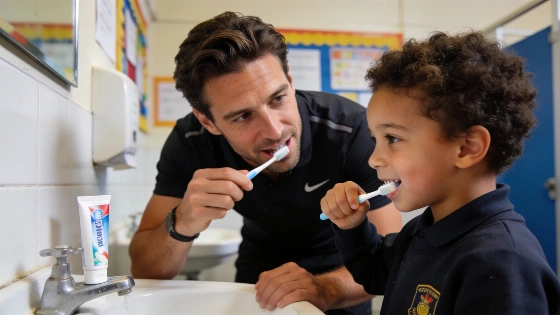
NHS England data reported in September identified tooth extractions as the most common reason for hospital admissions among five- to nine-year-olds. The claim could not be independently confirmed in the available official results. Against that backdrop, the government says its scheme delivered six million toothbrushes and toothpastes in its first year. Joe Wicks will encourage families to make brushing part of everyday life.
That is a substantial delivery figure.
On its own, it does not show whether children brush consistently or whether tooth decay is falling.
The available official results do not establish the scheme's exact cost, participating schools or regions, the number of children reached, regular brushing adherence or changes in tooth decay.
A campaign built around habits at home
The Department of Health and Social Care developed Brush With Us to help families establish positive brushing habits and reinforce what children learn in supervised sessions. Joe Wicks, a fitness coach and author, founded The Body Coach. He will front the campaign.
Wicks said: 'As a parent I know how busy family routines can be, but brushing for two minutes, twice a day is one small habit that can make a real difference to children's health and confidence. Children's oral health is part of their wider wellbeing and building good habits early can help set children up for healthier futures.'
Dental groups have welcomed the campaign, while warning that promotion cannot remove every barrier. Association of Dental Groups executive chair Neil Carmichael called Wicks "the perfect ambassador" to bring the message to life. The British Dental Association described supervised brushing as a "winning formula" and said it saves the NHS more than it costs to deliver.
The available results contained no primary statements from the Department of Health and Social Care or NHS England. They also lacked original statements from the BDA and Wicks, so those comments could not be checked against their original sources.
The Law Commission material in the available official results concerns a consultation on product liability, not preventive dentistry or supervised toothbrushing. It therefore does not provide evidence about this campaign or its outcomes.
Reach and access remain the tests
BDA chair Eddie Crouch said uptake had been low in some areas and hoped Wicks could bring "new momentum". He urged the government to restore access to care so children can get preventive help before problems become emergencies. In September, he blamed a "lack of political will to fix NHS dentistry" for the hospital extraction figures.
Northamptonshire offers a local example of the approach. Its supervised brushing rollout pairs sessions with oral-health lessons and free care packs for some families.
Carmichael also pointed to dentistry's workforce crisis. He said more international dentists qualifying through the Overseas Registration Examination and additional places opening at dental schools could help children's oral health "turn a corner". Colgate-Palmolive has committed to donating more than 23 million products over five years to support delivery of the scheme. Its senior marketing director Ricardo Cardenas said the company wants children to have the education and tools to improve their oral health.
Wicks gives prevention a familiar public face. Whether the campaign reaches children in areas with low uptake remains the central test. Six million deliveries establish the scheme's reach, but the available results do not show improved oral-health outcomes. The campaign can reinforce supervised brushing, but it cannot replace accessible dental care or the workforce capacity professionals say children need.
The Food Standards Agency Science Council's annual report covers 1 April 2025 to 31 March 2026 and does not discuss the dental campaign, according to the annual report for that period.