Six years of development went into Dyson's first oral-care device, which launched at $499 and carried 38 patents.
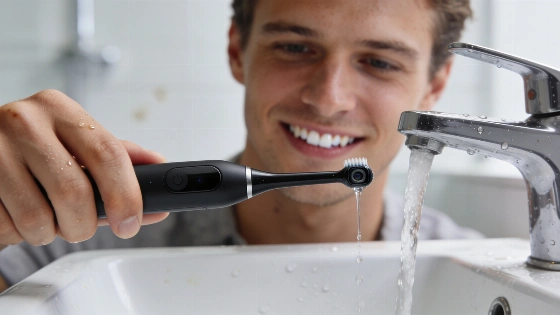
CameraJet sends the user a view from inside the mouth. It identifies gaps between teeth, then directs water or mouthwash toward them. The approach gives Dyson a way into oral care that depends on sensing as much as brushing.
The device combines WiFi AI intelligent sensing with fluid dynamics and a brushing system built for brushing and targeted interdental cleaning in one routine. Its 100,000-pixel intraoral camera captures 28 images per second. Machine-learning algorithms identify spaces between teeth and trigger a directed jet in about 100 milliseconds, according to a detailed product report.
The CameraJet's software includes about 16 million lines of code, and its machine-learning model was trained on 470,000 dental images.
A camera built into the brushing routine
CameraJet shows where the brush is working and where gaps remain. Its camera streams an internal view of the mouth while the system recognises spaces between teeth and directs fluid toward them for a flossing function. The liquid reservoir holds 12.5 millilitres, so the delivery system sits inside the same compact body as the brush.
The concept goes well beyond adding connectivity to a conventional toothbrush.
Jake Dyson, Dyson's chief engineer and son of founder James Dyson, has said a first product in a new category must be radically different and clearly separated from competitors. CameraJet follows that formula by joining oral-care hardware with sensing software and fluid delivery. Dyson has described the software and fluid-delivery system as core parts of the product, rather than optional connected features.
After the September 1, 2026 launch, Dyson began removing CameraJet from sale after reports that water could enter the battery compartment and disable the device. By October 5, it was still unavailable on Dyson's U.S. website; the company described the matter as affecting some early production batches rather than constituting a formal product recall.
Dyson delayed the launch to meet its standards
Dyson's move into oral care follows its expansion from household appliances into personal care. Its hair-styling products established the brand in that market. The 2016 launch of the Supersonic hair dryer showed how Dyson approaches established categories with a different product proposition.
Jake Dyson has said CameraJet needed to work properly before launch. The product could have appeared two years earlier, he said, but it would not then have met the company's standards.
Early reports linked the faults to an isolated production issue. Dyson later blamed a defective component in one manufacturing batch of the jet-module tubes. The company said it was isolating affected batches and supporting customers. It characterised the fault as limited to a small number of devices, as reported in BeautyMatter's account. Dyson said production and shipments continued, but it did not announce a formal recall.
A platform for a wider oral-care range
Dyson plans to expand quickly in oral care and has multiple products on its roadmap. The company says ideas and engineering systems move between product teams. Compact mechanics and battery technology are shared across the Airwrap, the Supersonic hair dryer, the PencilVac and the PencilMop.
That internal cross-pollination sits at the centre of the strategy. Dyson is applying technology developed in other product areas to oral care, with the aim of making the mouth visible and interdental cleaning more targeted.
CameraJet adds visual feedback and automated fluid delivery to the daily brushing routine. The launch marks Dyson's strongest attempt to reshape the category while the company works through early production faults and develops the wider range on its roadmap.
By September 15, 2026, the device had disappeared from Dyson sites in the United States. It was also absent from the United Kingdom site. Singapore followed, despite the company's position that production and supply were continuing.