
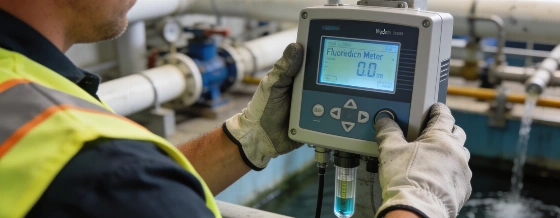
Stricter regulations are changing how water quality is monitored. In Asia-Pacific and North America, new rules on fluoride levels in drinking water and industrial wastewater are pushing more utilities and manufacturers to invest in fluoride ion meters. Market forecasts now expect global sales to grow at 5-7% per year from 2026 to 2035, with the market index reaching 175 by 2035 (2025=100).
Many municipal utilities, semiconductor plants, and mining operations are moving away from periodic sampling and switching to continuous, real-time ion monitoring. This shift is driven by the need to meet tighter discharge standards. Online and process-integrated meters now make up about 35-45% of new installations, showing that automation and reliable data are becoming standard requirements.
"In India, the Bureau of Indian Standards (BIS) sets the acceptable fluoride level in drinking water at 1.0 mg/L, but allows up to 1.5 mg/L where no alternative water source exists."
Law Prep Tutorial
Asia-Pacific leads this change, accounting for 40-50% of global unit sales. The region's growth comes from new semiconductor factories in Taiwan, South Korea, and China, as well as large water treatment projects in India and Southeast Asia. In North America and Europe, aging water systems and stricter enforcement of the Safe Drinking Water Act and EU Water Framework Directive are prompting utilities to upgrade from manual sampling to online analyzers.
Technology is also making a difference. IoT-enabled meters with cloud data logging and predictive maintenance features are reducing unscheduled downtime by 15-25% compared to older models. This supports higher prices and creates new business for service and consumables as more meters are installed.
There are still challenges. Electrode drift and membrane contamination account for 10-20% of total ownership costs. Supply chain issues for specialized electronics and membranes can sometimes delay deliveries, though overall production is expected to keep up with demand. Manufacturers also have to manage different national fluoride limits-ranging from 0.5 mg/L to 1.5 mg/L-which means more calibration and certification work and more complex inventories. According to a 2026 regulatory review, many countries still use 1.5 mg/L as the standard for fluoride in drinking water, highlighting the variation in global rules.
"In the United States, the federal agenda for drinking water contaminants in 2026 was primarily focused on PFAS. The EPA in May 2026 proposed to retain existing maximum contaminant levels (MCL) for PFOA and PFOS, granting certain systems additional time to comply, potentially until 2031. As of September 2026, these changes remained proposals rather than finalized federal rules, which is important for assessing regulatory pressure on U.S. water systems."
GuideChem, Industry Analysis
Competition is heating up, especially for portable and mid-range benchtop meters. Chinese suppliers are expected to lower average prices by 3-5% each year. Established brands are responding by focusing on high-end process analyzers and bundled service contracts, aiming to stand out through reliability and data integration rather than price.
For industrial users, especially in the semiconductor industry, 2026 materials show that fluoride levels in HF/BHF rinse wastewater can range from 10 to 100 mg/L and must be brought below 10 mg/L before biological treatment, since higher levels are toxic to activated sludge. Where stricter limits apply-including below 1 mg/L-ion exchange is preferred over reverse osmosis, as detailed in a 2026 industry analysis.
By 2035, fluoride measurement will be a routine part of process control and environmental compliance, with data analytics guiding operational decisions. The market for consumables and replacement parts will grow along with the installed base, providing steady recurring revenue even as hardware margins shrink.
Regulatory tightening and automation are now permanent features of this market. Companies that can deliver accurate, reliable, and integrated solutions will be best positioned as compliance becomes more demanding and downtime more costly.