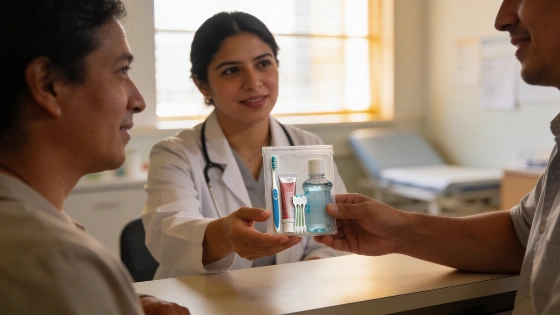
The $10,000 ACGME Back to Bedside grant will support a resident-led project at UT Health San Antonio. Sonrisa: Improving Patient Connection Through Oral Health Kits in an Underserved Population will give patients toothbrushes, fluoride toothpaste, floss and mouthwash. Residents also plan a short conversation about oral health and overall wellbeing.
The UT Health San Antonio system serves more than 2.5 million patient visits each year, placing the planned local oral-care intervention within a much larger care network.
That small intervention is the point.
A practical response to barriers patients already face
The clinic serves one of San Antonio's most economically disadvantaged populations. Dr. Eve Vanderneck said more than one-fifth of patients served by the health system do not have health insurance. Many also struggle to get food, housing and basic hygiene products.
Across the city, 17.1% of residents live below the federal poverty line. Another 16.9% live with at least one type of disability, and 18% do not have health insurance. Each figure is higher than the corresponding statewide average cited in the project's underlying materials.
UT Health San Antonio's dental school reports that students see more than 36,000 patients annually through community clinical rotations and provide about $5 million in uncompensated care each year. The figures indicate that the institution already has substantial infrastructure for serving underserved populations.
The plan may also help in existing well-child clinics. Children whose families do not have a dentist or cannot afford one currently receive information about low-cost dental offices. Under Sonrisa, residents will also offer brief guidance and basic tools for daily oral hygiene while a dental appointment is arranged.
The goal is practical.
Oral health as a route to trust
Alexis Ramos, MD, is mentoring the project. He is a family physician and assistant clinical professor in UT Health San Antonio's Department of Family and Community Medicine. Vanderneck is leading the work as a PGY-3 resident in the family and community medicine programme.
Ramos said periodontal disease is associated with higher systemic inflammation and worse outcomes in conditions such as diabetes and cardiovascular disease. Those conditions are common among the clinic's patients. Oral health is therefore not only a separate dental concern.
The project also fits the local population. About 65% of residents in the area identify as Latino or Hispanic. Patients may face transport problems or language barriers. Sonrisa takes its name from the Spanish word for "smile" and pairs tangible support with a discussion of oral health practices.
Earlier oral-health reporting has examined how access and routine behavior shape dental risk in very different populations. In San Antonio, the question is more basic: do patients have the tools to act on advice given in primary care?
Ramos said meeting patients where they are can build trust with communities that may distrust the healthcare system. Patients may be more willing to discuss and follow other health recommendations when clinicians show concern for the whole person, including dental health.
Trust matters here.
A small grant with a defined professional purpose
Back to Bedside is now in its fifth two-year grant cycle since its launch in 2017. The ACGME received more than 250 applications for this year's grants. Awards can reach $10,000.
Reviewers assessed each project for its potential to strengthen patient-physician relationships. They also considered sustainability, cost-effectiveness, defined outcome measures, innovation and adaptability to other training settings.
At the end of September 2026, the ACGME's latest materials included sections on rural and underserved graduate medical education. Those materials show that care for underserved groups remains part of the organization's educational and grant-related agenda.
UT Health San Antonio is also part of the AMA GME Competency Education Program. The program supports institutions working toward the ACGME Common Program Requirements through on-demand microlearning for residents. It is built for demanding clinical schedules and includes streamlined reporting tools for administrators.
Vanderneck said the initiative is meant to restore a humanitarian connection that residency pressures can obscure. The current cycle is scheduled to end with a presentation at the 2028 ACGME Annual Educational Conference in San Antonio.
Oral-health coverage in 2026 has continued to examine dental access for vulnerable groups as an area of research and clinical work. That context fits Sonrisa's combination of hygiene kits and brief counseling. Still, no authoritative public announcement identified in the available institutional materials confirms that Sonrisa has begun distributing kits. The materials do not report an IRB decision or completed distribution.
Sonrisa is a modest intervention with one clear strength. It links advice to an immediate, usable resource without suggesting that a toothbrush replaces a dentist. The real test will be whether the planned conversations and kits help residents build trust and give underserved patients a practical bridge to better oral care.
It is worth watching.