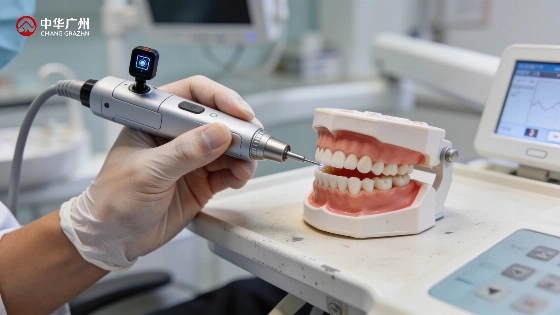
Inside a dental operatory, an embodied AI system would need to read conditions in the mouth before directing an instrument. A new narrative review describes technical work toward that goal, but finds much of the evidence remains in engineering and laboratory research. A smaller share has reached early clinical testing.
Embodied artificial intelligence combines AI with sensory technologies and robotics. The researchers see it as a clinician-supervised co-pilot, not an independent operator.
From sensing to procedure guidance
The review describes a sequence of connected tasks. A system gathers information from the clinical environment, then combines it with patient records and existing knowledge. It uses that information to plan treatment before guiding physical execution. Every stage depends on reliable data and on the system translating it into appropriate action.
In the mouth, force and haptic sensors could help robotic systems detect changes in mechanical resistance during implant procedures. Researchers have explored using them to identify anatomical landmarks and assess primary stability. Other work includes optical tracking designed to compensate for simulated patient movement. Orthodontic aligners that measure occlusal forces have also been studied for treatment monitoring.
A review of AI in oral and maxillofacial surgery screened 308 papers and included 37 studies. The studies covered diagnosis, data interpretation and surgical planning. Researchers examined anatomical landmark detection and the analysis of lesions and cysts. Other applications included assessing medication-related osteonecrosis of the jaw and planning implants. The review also covered fracture classification and temporomandibular joint disorders. Methods varied, performance measures were inconsistently reported, and external validation was limited. Its authors concluded that AI can assist clinical decision-making, but should not replace comprehensive examination or professional judgment, as detailed in the oral surgery review.
These capabilities remain under investigation. They do not prove that integrated AI systems improve patient outcomes.
Planning and action remain under evaluation
AI models that process different types of dental information could help systems use patient histories. Repeated examinations could add further data. The review also discusses methods from general robotic surgery that may let systems learn from earlier procedures. Whether those methods suit dentistry remains uncertain.
For treatment planning, studies have tested systems that use bone anatomy and prosthetic requirements to generate implant placement plans, including plans for zygomatic implants. Digital twins could simulate treatment scenarios and anticipate possible outcomes. During a procedure, robots can follow planned instrument paths, then adjust movement using sensor data.
Laboratory tests of robot-assisted endodontic microsurgery have reported promising accuracy. Small clinical case series offer early evidence of applicability. A separate scoping review found high implant placement accuracy with robotic systems.
One study of dynamic computer navigation for implant placement reported 100% implant survival through the last follow-up, with no recorded mechanical or biological complications. It evaluated a navigation method and the effect of alveolar ridge inclination on accuracy. It did not test an embodied AI system autonomously sensing and controlling an instrument. The findings appear in the implant navigation study. Dental Tribune International has also reported a full-arch rehabilitation case involving robotic implant placement. Its coverage includes laboratory research on robot-assisted preparation of recipient sockets for tooth autotransplantation.
Clinical evidence is still limited
The review draws on dental literature, alongside research from medicine and engineering. Relatively few studies compare approaches prospectively or follow patients over the long term. Much of the evidence comes from engineering work and in vitro experiments. Other studies use preclinical simulations. Clinical series remain limited.
A review of AI and imaging technologies in orthodontics considered 54 studies. It found that the evidence base leaned heavily on retrospective, single-centre model-development studies with internal validation. Image-processing tasks have reached the strongest level of clinical maturity. Robotic and automated procedures remain experimental. Technical accuracy alone does not establish better treatment outcomes. Prospective evaluation and independent validation remain important, as outlined in the orthodontic imaging review. Technical feasibility in some applications therefore does not establish the effectiveness or long-term safety of integrated EAI systems.