Intraoral scans, CBCT images and CAD software can now guide a restoration from a patient's mouth to temporary teeth within days. The workflow combines virtual implant planning with chairside or in-house milling.
A 2026 dental-tourism page aimed at patients estimates that Turkey receives about 300,000 dental tourists annually, illustrating the scale of the market behind same-trip implant and restoration packages.
One mouth becomes several digital models
The process starts with an intraoral scanner. The wand-sized camera captures images across the teeth and joins them into a three-dimensional surface model. The result is usually an STL mesh.
Structures beneath the gums need a different scan. Cone beam computed tomography produces a three-dimensional view of jawbone density, the lower-jaw nerve canal and the sinus floor above the upper teeth.
The clinician can combine the surface scan with the CBCT volume. The result is a digital twin of the mouth. Both datasets are still needed in most clinical digital workflows. CBCT supplies hard-tissue information. The intraoral scan adds soft-tissue, tooth-surface and occlusal data for complete prosthesis design, according to an ITI-based workflow guide.
The wider move toward digital imaging is covered in a digital imaging report. The clinical value here comes from connecting the data to treatment. Storing another scan is not enough.
The virtual model lets clinicians position and angle implants before surgery. That plan can become a 3D-printed surgical guide. Sleeves in the guide limit the drill's position, direction and depth.
The 2025-2026 AAE/AAOMR update organizes its guidance into 12 recommendations and says CBCT should be prescribed selectively rather than used as routine screening. It also aligns with recent ADA/AAOMR findings that lead aprons and thyroid collars are not generally recommended for CBCT, although local rules may still apply.
The laboratory moves beside the dental chair
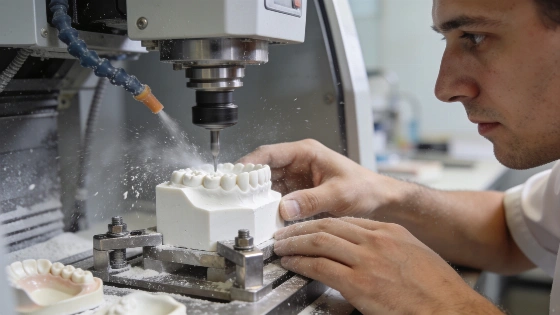
After implant planning, CAD software can model the replacement teeth. It can also simulate the bite before manufacturing starts. A 5-axis milling machine may carve the design from a solid block of zirconia or glass-ceramic.
When the scanner, design workstation, mill and furnace sit in the same clinic, work that once went to an outside laboratory can finish in days.
The lab is close.
This setup matters most in full-arch treatment. Package-style care in Turkey can combine scanning, implant surgery, laboratory production and temporary teeth in one trip. The faster manufacturing schedule does not change the biological timetable of implant treatment.
Acıbadem says its international dental-tourism services operate under the license and supervision of the Republic of Türkiye Ministry of Health and within the HealthTürkiye programme. That is one example of how cross-border care is formally organized.
Vendors are still refining the workflow. Product-news coverage reported that DEXIS announced new digital-imaging features in late September 2026. The changes included Motion Correction for CBCT units, a slimmer scanner tip and expanded intraoral-scanner cloud connectivity.
Precision does not cancel biology
Modern machining has made some implant connections easier to produce consistently. Conventional systems use a small internal screw. It can loosen over years of chewing. The screw also creates a channel that may collect bacteria.
Screwless designs use a precisely angled conical connection related to the Morse taper used to hold a drill bit in a drill press. The components lock through friction. Manufacturing accuracy is central to their reliability.
The main limit is not the milling machine. Titanium implants still need to fuse with surrounding bone through osseointegration. That process takes around three to six months.
Healing sets the pace.
Many full-arch patients therefore make two trips. The first covers implant placement and temporary teeth. Months later, the patient returns for the final restoration.
Travel creates a basic record-keeping duty. The U.S. Food and Drug Administration advises patients to ask which brand and model of implant system was used. Patients should keep that information because implant components are not universal.
A dentist providing follow-up care at home needs to know exactly what was placed.
The evidence supports a measured view. Digital milling is a real logistical advance. It can make complex restorative care faster and easier to arrange across borders.
It does not replace surgical judgment, implant-system compatibility or bone healing. The strongest workflow connects precise manufacturing with realistic biological timelines. It also gives the patient's next dentist dependable treatment records.