
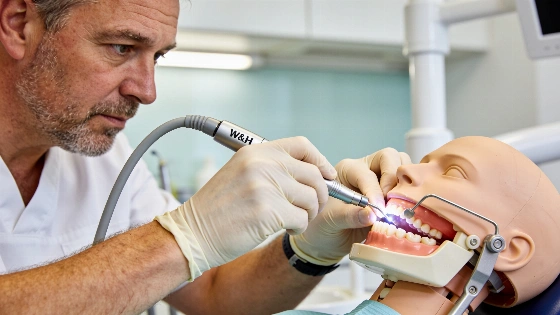
Swapping out weak air turbines for W&H handpieces changed everything for James Baker. The move from noisy, slow tools to precise rotary instruments wasn't just a step up. It changed how he worked every day.
W&H's current dental portfolio includes electric motors and contra-angle handpieces designed for restorative, endodontic, implant, and prosthetic workflows, reflecting the company's commitment to high-performance dental solutions.
That first experience with the 1:5 handpiece set a new bar for Baker. When he opened his own practice, he bought a full set of W&H handpieces: 1:5 for friction-grip burs, 1:1 for latch-grip, 4:1 for endodontics, 20:1 for implants, and 1:1 straight for adjusting prostheses. The key was always the same-versatility and accuracy, with electric motors that let him set the right speed and torque for any job.
Teaching has only made him more sure. When he trains postgraduate dentists on indirect restorations or runs hands-on composite courses, these handpieces are always in his kit. Their shape and grip help a lot, especially when working on back teeth or wearing gloves that don't grip well. Built-in LED lights and focused water spray make it easier to see and keep things cool, without flooding the area.
A W&H implantology unit is specified with a rotation range of 300-50,000 rpm, illustrating the advanced electric-motor performance available for surgical and implant procedures. This wide speed range supports both delicate and high-torque applications in modern dental workflows.
Looking back, Baker sees a clear difference. He no longer struggles with just two basic handpieces. Now his workflow is smoother and much more capable. Going back to old tools isn't an option.
For Baker, W&H handpieces are more than just tools. They're the backbone of a modern, efficient dental practice. If you care about precision and flexibility, the lesson is simple: the right equipment isn't a luxury. It's what makes every procedure and every teaching session better.
The W&H Dental Newsroom reports that as of September 2026, the company is still developing and supporting its dental imaging and workflow equipment. This shows ongoing innovation, not a discontinued product line.
Independent marketplace listings show that "speed increase 1:5" contra-angle handpieces are a standard product in dentistry, not a niche. Marketplace data confirms that this technology is widely used.