
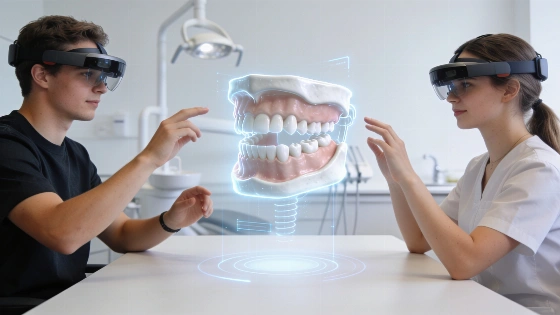
Dental schools are starting to use mixed reality (MR) in the classroom. A new pilot study led by Prof. Murali Srinivasan at the University of Zurich shows that MR can give students an immersive, hands-on way to learn, with few physical complaints. The study found that dental undergraduates not only handled MR-based teaching well, but also felt more engaged and enjoyed the experience.
A 2026 study in Education and Information Technologies found that immersive virtual reality simulations can significantly improve learning outcomes for medical students, highlighting a broader shift toward XR and MR environments in healthcare education.
The results were clear. Fatigue and eye strain went up, but nausea, dizziness, and disorientation stayed about the same. There was no difference between male and female students. Most students said they felt deeply involved and motivated, with a strong sense of competence and little pressure or tension during the session.
But the MR experience was mostly solo. Students said they did not feel much social connection or group interaction. This points to a gap: MR is good for pulling students into 3D content, but it does not yet support teamwork or group learning in its current form.
The Journal of Dental Education has recently published research on the integration of artificial intelligence and personalized learning in dental curricula, reflecting an active re-evaluation of teaching methods in the field.
The findings match earlier research from around the world. Immersive tech is still rare in dental schools, often because of limited resources or staff pushback. But this pilot shows students are open to MR-based learning, as long as physical demands like session length and eye fatigue are kept in check. The researchers also said that tweaking system settings to reduce sensory conflict could help cut down on cyber-sickness.
The study, published in the December 2026 issue of the Journal of Dentistry and titled "Evaluation of student attitudes in adopting mixed reality-based learning (MRBL) approach in dental curriculum: A pilot study," gives a real-world look at what it takes to bring MR into dental training. The next step, according to Prof. Srinivasan, is to see if these positive first impressions actually lead to better knowledge retention and clinical skills.
MR stands out for making complex spatial ideas easier to grasp and more interesting for students. But new tech in dental education should prove its value, not just offer novelty. This study suggests MR can be a strong tool for individual learning, as long as its physical and ergonomic limits are managed. The field will be watching to see if this early excitement leads to better clinical results and deeper understanding for future dentists.
A 2026 review in Education and Information Technologies reports that immersive and digital learning is picking up speed in both medical and dental education, with MR and XR tools now seen as a natural part of the digital shift in teaching.