
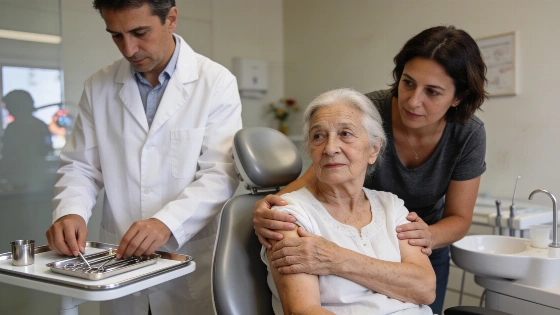
Dental pain often goes unnoticed in people with Alzheimer's. The disease erases memory and makes it hard to speak up. Infections go untreated. Warning signs get missed. Suffering builds quietly, and much of it could be avoided.
A 2026 Japanese study found that participants with the highest levels of gum bleeding had a 61% higher risk of developing Alzheimer's disease compared to those with minimal bleeding.
People with Alzheimer's forget to brush. Some lose the ability to use their hands well. Others no longer understand why oral hygiene matters. The Council's review shows what happens next: more cavities, both on the surface and at the roots, changes in the gums and mouth lining, and more problems from dry mouth. Medicines and changes in diet make things worse. Dentures become a problem too. When cleaning routines fall apart and no one checks if they fit, infections can start and spread.
In later stages, patients can't say when something hurts. Dental pain shows up as changes in behavior-refusing to eat, getting irritable, trouble sleeping, or making odd movements with the face. These signs are easy to miss. Many patients end up suffering in silence.
A 2026 review in BMC Oral Health highlights that poor oral health-including tooth loss, periodontal disease, and inadequate dental care-is consistently associated with a higher risk of dementia across multiple studies, though a direct causal link has not been established.
Everyone needs to work together. Dentists, doctors, caregivers, and families all have a role, especially when eating, swallowing, or hygiene become hard. Castro says, "Preventing an infection, relieving pain that they may not be able to communicate, or allowing them to continue chewing comfortably are interventions that directly impact their well-being and quality of life."
Researchers have studied the link between oral health and Alzheimer's for years. The Council is clear: there is no proof that one causes the other. There are patterns-people with dementia often have more gum disease and lose more teeth. But saying that good oral health prevents Alzheimer's is not backed by evidence. Castro warns against false claims. He says gum disease must be treated for its own sake, not as a sure way to stop dementia.
This warning fits a bigger problem. Many vulnerable people are already missing out on dental care. As reported earlier, older adults are often targeted by false ads and face real barriers to getting good dental care.
Ignoring oral health in Alzheimer's patients is not a small mistake. It puts dignity and quality of life at risk. The facts are clear: without early, coordinated care, these patients decline quickly-and it doesn't have to be this way. Dentists have a duty to keep oral health on the front line, not let it slip away as memory fades.