
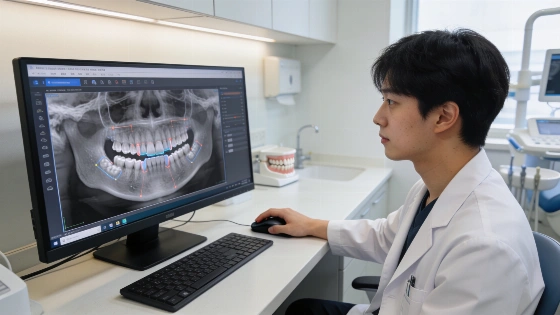
Researchers at Hallym University's Graduate School of Clinical Dentistry have developed an artificial intelligence system that cuts the time needed for three-dimensional virtual orthognathic surgery planning by more than half, without losing the accuracy clinicians require.
The study, published in 'Scientific Reports', compared the AI method directly with traditional manual planning. Using the ON3D program, the AI achieved skeletal positioning accuracy nearly identical to manual methods. At key upper jaw reference points, the average difference was about 1 mm.
The AI-driven ON3D system reduced the time needed to mark anatomical landmarks on CT scans from 10.5 minutes to just 4.2 minutes per case.
The biggest change is in efficiency. Where clinicians previously spent around 10.5 minutes marking anatomical landmarks on CT images, the AI system finished the same task in 4.2 minutes. Total planning time dropped from 17-18 minutes to just 7-9 minutes. For busy surgical centers, this is a significant improvement in workflow.
Orthognathic surgery, which corrects jaw alignment for facial asymmetry or severe malocclusion, requires careful preoperative planning tailored to each patient. Until now, this meant manually identifying skeletal and dental landmarks-a time-consuming process. The Hallym team, including Sehoon Baek, department head Suh Whan Byun, dean Byungun Yang, and a collaborator from Karolinska University Hospital, compared three approaches: conventional manual software, manual planning with ON3D, and ON3D's AI-powered automatic measurement.
Each virtual plan was checked against CT scans taken one week after surgery to see how closely the predicted and actual jaw positions matched. The AI's results were statistically similar to manual planning at most major skeletal points, showing that faster planning did not reduce precision.
Recent systematic reviews from 2025-2026 emphasize that AI in dental and surgical planning is best viewed as a decision-support tool, not a replacement for clinical expertise. These reviews highlight the importance of human oversight in ensuring patient safety and optimal outcomes.
- Reuters, Healthcare AI coverage
By automating repetitive landmarking tasks, the researchers say AI could ease clinicians' workloads and streamline planning, especially in high-volume centers or where teams from different specialties need to collaborate. The team is planning larger multicenter studies and long-term follow-up to further test the safety and reliability of AI-driven planning.
When a process as critical as surgical planning becomes both faster and just as accurate, it can change daily practice. The Hallym University team's results suggest that AI is now a practical tool for improving surgical workflows in real-world dental care.
According to a Dental Planning Lab summary citing recent systematic reviews, the broader trend in digital surgery is to use AI as an adjunct to clinical judgment, supporting-but not replacing-the expertise of surgeons and dental specialists.