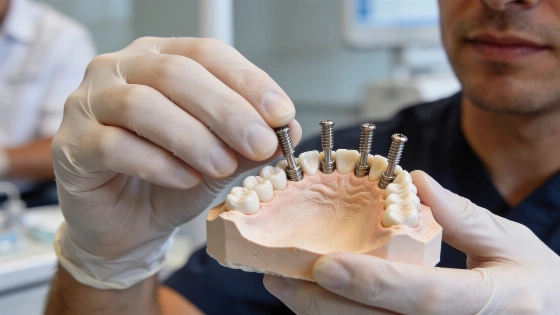
Before the posts go in, the oral surgeon checks whether the patient qualifies for All-on-Four treatment. The process may include removing unhealthy teeth or adding bone grafts. Titanium posts are placed only after the jaw has enough support.
The metal has a practical job. It must carry the load of a full arch while the surrounding bone heals around it. San Francisco Dental Implant Center says titanium offers the strength, light weight and bone compatibility needed for that role.
That choice affects comfort.
All-on-4 uses four strategically placed implants, with the rear implants angled to maximize available bone contact and reduce the need for grafting in selected cases.
Dr. Alex Rabinovich founded the San Francisco practice. He says titanium's introduction to the public in the 1980s helped advance dental implant surgery. "Patients can live comfortably knowing the light metal is a permanent foundation for a healthy smile," he said.
Patients also ask how long the posts may last. A National Library of Medicine review calls titanium the standard implant material. It explains that osseointegration allows bone to join with the implant and support long-term stability. The process is described in an NIH implant review.
All-on-Four is not a one-visit treatment for every patient. The surgeon may first remove teeth that cannot be saved. Some patients need bone grafting. After the bone has regenerated, the titanium posts are installed, and the gums and jaw need time to adhere to them.
The approach uses four implants placed in specific parts of the jaw. The rear implants are angled to increase bone contact. In selected cases, that can reduce the need for grafting. The treatment remains case-dependent.
Recovery comes first.
Temporary functional teeth are used during healing. The final surgical step typically takes place during a brief visit. The oral surgeon attaches the dental implants to the posts. Angled abutments help form a secure arch designed to create a natural-looking smile.
FDA device records show that dental implant systems continue to be cleared as medical devices through the 510(k) pathway, including titanium root-form systems. Regulatory clearance does not remove the need for patient-specific planning and clinical evaluation.
FDA records continue to list dental implant systems as medical devices cleared through the 510(k) pathway. The database includes titanium root-form systems and multiple related implant devices. Clearance does not replace patient-specific planning or clinical evaluation.
The center's announcement comes as dental providers place implant treatment within a wider replacement-tooth market. An earlier market analysis examined how larger care networks and changing procedure volumes are reshaping that field.
Dr. Rabinovich is a board-certified oral surgeon. His background includes maxillofacial, oral and facial plastic surgery. His patients have included people with genetically bad teeth and people who experienced oral trauma after illness or an accident.
Titanium is not just a technical detail in this treatment. It connects the jaw to a full arch of replacement teeth and carries the force placed on that arch.
Strength, biocompatibility and long-term comfort are the practical points patients need to understand before considering All-on-Four restoration. Clinician-facing materials continue to describe titanium as the standard implant material. Zirconia is generally presented as an option for selected aesthetic or sensitivity-related cases, not as a universal replacement.