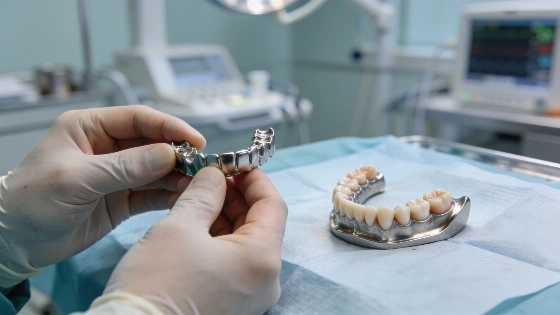
A woman in her sixties received a customized titanium lower jaw and temporary teeth at HMC's Surgical Specialty Center. Severe jawbone atrophy had ruled out traditional implants.
Hamad Medical Corporation describes itself as Qatar's main public healthcare provider, placing the newly announced service within the country's public health system.
Dr. Khalid Abdel-Galil, Senior Consultant and Chair of the Oral and Craniomaxillofacial Surgery Department, led the team. The patient had lost all of her lower jaw teeth. She needed reconstruction before permanent dental rehabilitation could begin.
HMC identifies itself as Qatar's principal public healthcare provider. The service therefore sits within the country's public health system.
Digital planning made the difference.
Before surgery, the clinical team used three-dimensional imaging and virtual surgical planning to create a digital model of the patient's jaw. That model guided the design of the customized surgical components.
HMC's dental-services network includes specialized clinics in multiple locations, including a Dental Center at Rumailah Hospital, supporting the multidisciplinary structure described for specialist treatment.
"The procedure involved the use of three-dimensional printed models to plan the surgery in advance and ensure that the reconstructed components matched the patient's anatomical structure," Dr. Abdel-Galil said. He added that the approach improves surgical efficiency and supports stronger long-term outcomes.
The new lower jaw uses high-purity medical-grade titanium. It was designed to remain in place for the patient's lifetime.
Temporary prosthetic teeth were fitted immediately after reconstruction. A dental surgeon will place the permanent teeth after the patient's condition stabilizes.
Suitable patients can receive functional teeth directly after surgery. They may avoid a prolonged period without dental function.
HMC says the approach can support chewing, speech and normal breathing. It also preserves facial appearance and may help patients regain confidence in social and professional settings.
The process starts with a referral to the Department of Prosthodontics. A multidisciplinary consultation then brings together the Oral and Craniomaxillofacial Surgery and Prosthodontic teams.
Those teams set the treatment plan and manage care from assessment through treatment. HMC's outpatient-clinic guidance also says specialized care is generally accessed through referral.
This is a practical use of virtual planning and 3D printing. It gives some patients an option when conventional implants are not suitable.
The procedure expands specialist oral and maxillofacial care in Qatar. HMC's institutional healthcare profile places that work within Qatar's public medical system.
The available public material confirms the procedure and HMC's claim that it was the first of its kind in Qatar. It does not establish the number of similar operations, the implant's cost, a case-specific regulatory decision or a detailed clinical protocol.
No separate comments from a regulator, independent expert or outside clinic were identified in the reviewed material.