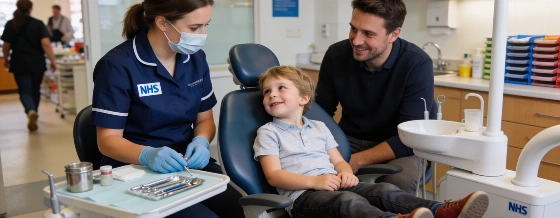
Children in Lancashire and South Cumbria are now more likely to see an NHS dentist than anywhere else in England. This is a major turnaround for a region that has struggled with poor oral health for years. New NHS figures show that 65.1% of under-18s in the area saw a dentist in the past year-seven percentage points above the national average, according to a report from NHS Lancashire and South Cumbria ICB.
This progress comes from a targeted child dental access scheme run by the region's integrated care board. The scheme focuses on communities that have often missed out on dental care, including Barrow, Blackburn with Darwen, Blackpool, Burnley, Chorley, Hyndburn, Kendal, Lancaster, Pendle, Preston, Rossendale, West Lancashire, and Wyre.
The 65.1% child dental attendance rate in Lancashire and South Cumbria is the highest among all integrated care boards in England for 2025/26.
"We are delighted to see that more children in our area have accessed an NHS dentist, but not surprised. A lot of work has been done specifically to address the issue and providers and partners have been unified in helping us improve," said Amy Lepiorz, associate director of primary care for NHS Lancashire and South Cumbria ICB. She credits the results to a coordinated effort to reach children most at risk.
The scheme is simple. Any child up to age 17 without a regular dentist can be referred using a short form, and some practices accept walk-ins. Children are matched to the nearest participating dental practice, which then contacts parents or carers to set up appointments. The aim is to reach those who have missed out, especially in areas where oral health has lagged behind national standards.
Ms Lepiorz is clear about why this matters: "Ensuring children can see a dentist regularly is vital to identifying problems early, improving oral health and reducing inequalities. Our targeted scheme provides access to NHS dental care for children who do not have a regular dentist, particularly in communities where access and oral health outcomes have historically been poor." She points out that children in the most deprived areas face the highest risks, making these efforts essential.
Alongside better access to dentists, local authorities are running supervised toothbrushing schemes in schools and community settings. The ICB works with dental practices, health and care services, schools, voluntary groups, and community organisations to make sure care is available close to home.
In the past year, 237,374 children in Lancashire and South Cumbria saw an NHS dentist-the highest proportion for any integrated care board in England. Adult dental access is also above average, with 43.5% of adults in the region seeing an NHS dentist over two years, compared to the national figure of 39.8%.
Lancashire and South Cumbria stand out not just for the numbers, but for focusing on deprivation and trying new ways to reach families. The results show that targeted action and local partnerships can make a real difference in tackling health inequalities.
The scheme is simple. Any child up to age 17 without a regular dentist can be referred using a short form, and some practices accept walk-ins. Children are matched to the nearest participating dental practice, which then contacts parents or carers to set up appointments. The aim is to reach those who have missed out, especially in areas where oral health has lagged behind national standards.
The regional child dental attendance rate of 65.1% in Lancashire and South Cumbria is 7 percentage points higher than the England average of 58.1% for 2025/26, as published on 17 September 2026.
Ms Lepiorz is clear about why this matters: "Ensuring children can see a dentist regularly is vital to identifying problems early, improving oral health and reducing inequalities. Our targeted scheme provides access to NHS dental care for children who do not have a regular dentist, particularly in communities where access and oral health outcomes have historically been poor." She points out that children in the most deprived areas face the highest risks, making these efforts essential.
Alongside better access to dentists, local authorities are running supervised toothbrushing schemes in schools and community settings. The ICB works with dental practices, health and care services, schools, voluntary groups, and community organisations to make sure care is available close to home.
In the past year, 237,374 children in Lancashire and South Cumbria saw an NHS dentist-the highest proportion for any integrated care board in England. Adult dental access is also above average, with 43.5% of adults in the region seeing an NHS dentist over two years, compared to the national figure of 39.8%.
Lancashire and South Cumbria stand out not just for the numbers, but for focusing on deprivation and trying new ways to reach families. The results show that targeted action and local partnerships can make a real difference in tackling health inequalities.