
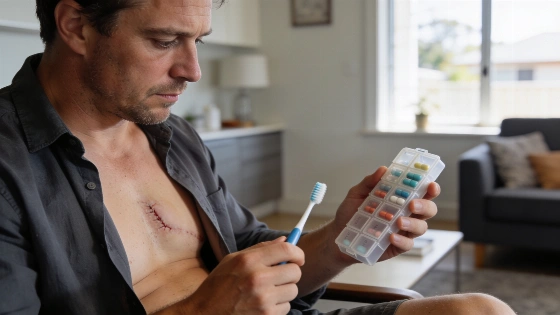
Luke Woodhouse never expected a toothache to end with open-heart surgery and a lifetime of medication. But that's what happened after a dental abscess set off a chain of medical emergencies, destroying one of his heart valves and nearly killing him.
At 35, living in Moreton Bay, Australia, Woodhouse brushed off the pain at first. He'd had toothaches before and didn't think much of it. Within days, though, things changed fast. Bacteria from the abscess entered his bloodstream, causing sepsis-a dangerous, body-wide reaction to infection. The infection reached his heart and led to infective endocarditis, which destroyed a valve.
Infective endocarditis caused by dental infections can lead to rapid valve destruction, sometimes requiring emergency mechanical valve replacement within days of diagnosis.
"What I didn't realize was that bacteria from a dental abscess had entered my bloodstream and caused a serious infection," Woodhouse said. He only understood how serious things were when a doctor told him, "Your blood is infected." By then, he was confused, had diarrhea, chest tightness, chills, slurred speech, and delirium. He grew so weak he could barely walk.
Doctors moved quickly. Woodhouse needed open-heart surgery to remove the infected valve and replace it with a mechanical one. The news was overwhelming. He worried about missing work and the strain on his wife, Jennifer. Then he learned he would need to take anticoagulant medication for life. "It was only when the pharmacist sat down with me and explained what lifelong anticoagulation therapy would involve that the reality of how different my life was going to be really hit me," he said. "That was a very low point for me."
According to News Minimalist, Woodhouse's case was widely reported as a warning about how untreated dental infections can escalate to sepsis and endocarditis, sometimes requiring emergency valve replacement. Queensland Health confirmed that his open-heart surgery and valve replacement happened within a week of his condition worsening.
Current dental guidelines emphasize that for most healthy adults, the primary treatment for dental abscesses is drainage or removal of the infection source, with antibiotics reserved for cases showing systemic involvement or spreading infection.
- Dental Guidance Summary (source)
Recovery was rough. Woodhouse had hallucinations in intensive care and suffered a partially collapsed lung that needed fluid drained. "During that procedure, my entire body would spasm and lock up," he said. "It was frighteningly painful and one of the most difficult parts of the whole experience."
A year later, his daily life looks very different. He's strict about dental care, avoids walking barefoot outside, and pays close attention to any cuts or signs of infection. Taking warfarin is now part of his routine. "They're things I never really had to think about before, but now they're simply part of everyday life," he said.
Looking back, Woodhouse says the seriousness of an illness isn't always obvious. "If I had waited another day before going to the emergency department, I might not be here today," he said. The experience changed his priorities, making him focus more on family, friends, and faith. He now shares his story to raise awareness about the link between oral and heart health. "If sharing what happened to me encourages even one person to take their dental health or unusual symptoms more seriously, then I think something positive has come from an incredibly difficult experience."
Woodhouse's story is a clear example of how ignoring dental problems can have severe, lasting consequences. The link between oral infections and life-threatening conditions like sepsis and endocarditis is real. For anyone tempted to ignore dental pain or delay treatment, his experience is a direct warning: dental health matters, and the risks of waiting can be permanent.
According to American Heart Association guidelines, antibiotics to prevent endocarditis are only recommended for a small group of high-risk patients, such as those with prosthetic heart valves or a history of endocarditis-not for most people with dental infections.