
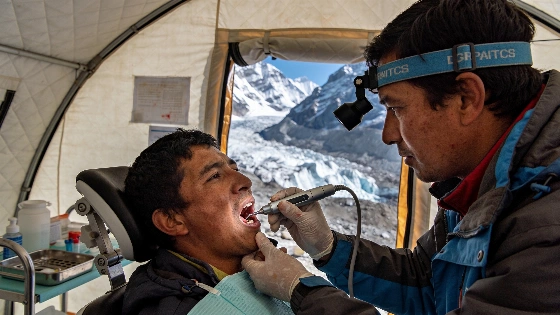
Organisers plan to open the heated clinic at Everest Base Camp in spring 2027. It will run for six weeks and handle up to 1,000 visits. Sherpa guides, Icefall Doctors, porters and route workers will be the main patients. Their work keeps expeditions moving through the Khumbu Icefall and toward the higher camps, according to the Kathmandu announcement.
Dental problems are difficult to manage at altitude. Workers have little access to specialist care.
The Everest dental clinic plan was formally announced in Kathmandu on 29 September 2026 for the spring 2027 climbing season.
The project is called the Everest Lhotse Dental Expedition 2027. Seven Summit Treks Pvt Ltd signed a memorandum of understanding with the initiative on Monday.
Seven Summit Treks will manage the Nepal expedition framework. Its duties will include Base Camp infrastructure, cargo and helicopter logistics, permits, stakeholder coordination and local operations. The expedition team will keep control of clinical decisions and medical work.
Dr Aizhan Zhumabayeva will lead the independent humanitarian mission. She is licensed as a dental surgeon in Turkey, Dubai and Kazakhstan. About a week before the main climbing groups arrive, she plans to bring an international and Nepali team to Base Camp.
The team will include dental professionals, assistants, an emergency physician and an operations director. Between 10 and 12 people will be based at Base Camp at a time. Round-the-clock dental support is planned during the main summit push.
That is a demanding setup.
The clinic will use a heated, insulated tent. Inside, the team will install three portable dental treatment units, sterilisation equipment, power and clean-water facilities.
Seven Summit Treks Pvt. Ltd. is identified as the official expedition and logistics partner in Nepal under a memorandum of understanding signed in Kathmandu.
"The people who make expeditions to the world's highest mountains possible deserve access to healthcare where they work," Dr Zhumabayeva said. "Our goal is not simply to bring dentists to Everest Base Camp, but to establish a fully operational dental clinic and provide care throughout the entire Spring 2027 climbing season, working alongside Nepalese professionals."
Sherpa workers and other high-altitude workers will receive treatment free of charge. Climbers and expedition members who use the clinic will also pay nothing.
Voluntary donations to the Everest Dental Expedition Foundation will fund future missions. The organisers plan to take the next operation to Manaslu Base Camp in autumn 2027. They then want to reach remote villages and high-altitude monasteries with limited dental access.
The plan resembles the access-focused approach described in an earlier dental access report. Everest will bring much harsher logistical conditions.
Chhang Dawa Sherpa said dental hygiene is often one of the least prioritised concerns for high-altitude workers. He said the initiative could help more Sherpas recognise its value.
The partners also want the expedition to promote responsible climbing practices and document the healthcare needs of mountain workers. They plan to showcase Nepal and the Everest region. The expedition is seeking Guinness World Records recognition for its high-altitude dental work. Thaneswar Guragai said applications are being prepared for three titles involving Dr Zhumabayeva and the initiative.
The test will come at Base Camp.
If the organisers provide the promised equipment, staff and sustained access, dental care will sit alongside the infrastructure of high-altitude work. It will no longer be treated as an afterthought. The Everest plan could become a humanitarian service and a test of whether expedition logistics can support repeatable oral-health care in places that conventional clinics cannot reach.