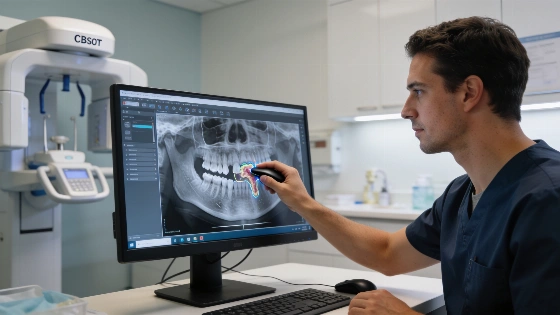
VELMENI's V4D 3D software just landed FDA clearance, joining a small group of AI dental imaging tools now approved in the US. This July 23 decision makes it the fifth 3D dental AI to get the green light. Software makers are moving fast, each trying to push CBCT scans beyond the hands of specialist radiologists and into daily dental practice.
Overjet's funding reached $133 million by March 2024, following a $53.2 million Series C round led by March Capital, with a post-money valuation of $550 million.
Overjet came next, rolling out CBCT Assist in December 2025. Its tool goes beyond anatomy-it also measures restorative structures. Dentsply Sirona and Diagnocat both got FDA clearance in January 2026 for their own AI tools. These focus on flagging possible periapical radiolucencies. Dentsply Sirona's Smart View - Detect and Diagnocat's CBCT review software are built to help clinicians spot specific findings in scans, not to make a diagnosis. Both are meant as second-read aids. The final call always stays with the dentist.
VELMENI's V4D 3D platform, now FDA-cleared, takes things further. It segments and labels a wide range of anatomical structures-teeth, mandible, mandibular canal, maxillary sinuses, temporomandibular joints, and airway. It can also create reconstructed panoramic views from CBCT data. The FDA cleared it for patients 15 and older with permanent teeth. VELMENI's submission included performance tests on 127 de-identified images from four US dental offices. The company named Pearl's Second Opinion 3D as its predicate device, showing how quickly this field is evolving and how companies are benchmarking against each other.
Dentsply Sirona's Smart View-Detect, which received FDA clearance, is publicly positioned as an AI diagnostic aid for CBCT scans that supports second reads and clinical decision-making, but does not make diagnoses independently.
This wave of regulatory approvals fits a bigger trend in dental tech. As reported earlier, AI-driven dental software is gaining ground across North America. The FDA's recent run of clearances for CBCT review tools shows both the hunger for new technology and the agency's insistence on keeping clinical responsibility clear.
With five FDA-cleared AI tools now on the market for CBCT imaging, US dentistry is at a turning point. The real test is whether these tools can boost diagnostic accuracy and fit smoothly into daily work-without sidelining the dentist's expertise. For now, the rules are clear: AI can help, but the dentist has the final say. The companies that manage to deliver useful insights while respecting clinical judgment will shape the next chapter in dental imaging.