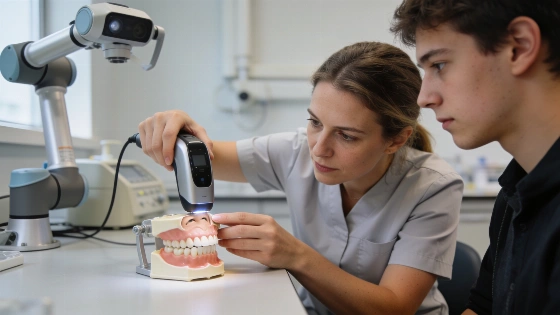
On Sept. 18, more than 50 dental professionals and students gathered at Case Western Reserve University to examine AI, digital scanning and robotic systems.
The U.S. Food and Drug Administration's September 2026 register included a dedicated dental category among its listings of AI-enabled medical devices, reflecting the growing presence of artificial intelligence in regulated healthcare technology.
The central question was practical. How can these tools move beyond demonstrations and into patient treatment and dental training?
Technology was not the point.
Interim School of Dental Medicine Dean Dale Baur opened the programme by linking new tools to clinical responsibility. "Patients are the reason we do this work, and they are the reason we are gathered here today," said Baur. "This symposium is, above all, about better patient care-about how these tools can improve precision, strengthen learning, reduce stress in practice and ultimately help us deliver better outcomes for the people who count on us."
Presentations and live demonstrations covered digital full-arch and guided surgery workflows. The programme also included advanced facial scanning, digital smile design, pre-surgical fabrication and robotic navigation systems.
An international assessment of 11 commercial AI systems for periodontology found that, depending on the system, up to 46.7% of responses contained at least one element rated poor or dangerous.
Artificial intelligence formed the other major part of the symposium. Speakers discussed virtual patients, automated diagnostics and data-based planning for universities and dental practices.
Education sat alongside clinical decision-making. The two areas were treated as connected, not as separate technology markets.
Dental education research is moving in the same direction. An online early-view article in the Journal of Dental Education, published Sept. 23, 2026, examined how closely ChatGPT responses on antibiotic prophylaxis in endodontics matched clinical recommendations, according to the journal's publication listing.
The tools are moving beyond isolated demonstrations.
A 2026 industry review found that 43.3% of dentists used AI for at least one task in practice. Another 26.4% said they did not use it yet but planned to do so. The FDA continues to update its register of AI-enabled medical devices. That gives schools and clinics a regulatory reference as new products enter the market.
The symposium also set a clear limit. Digital tools matter only when they improve the patient's experience or help clinicians provide reliable care.
Speakers connected precision with smoother workflows and less stress for practitioners. Patient outcomes remained the measure of success.
That standard matters.
Commercial imaging companies are linking AI with visualisation and workflow software. In a Sept. 23 statement, DEXIS said its portfolio-wide imaging innovations "help clinicians see more clearly" and support clinical decisions and outcomes. The statement points to a market moving toward connected systems instead of standalone applications.
The Department of Comprehensive Care, Roe Dental Laboratory, Nobel Biocare and Straumann supported the symposium.
Case Western Reserve University's event points to a practical path for dental innovation. The strongest model is not the biggest AI claim or the most futuristic device. It is the careful use of digital planning, education and clinical work to improve patient care.
That is where dentistry's digital future gains credibility.